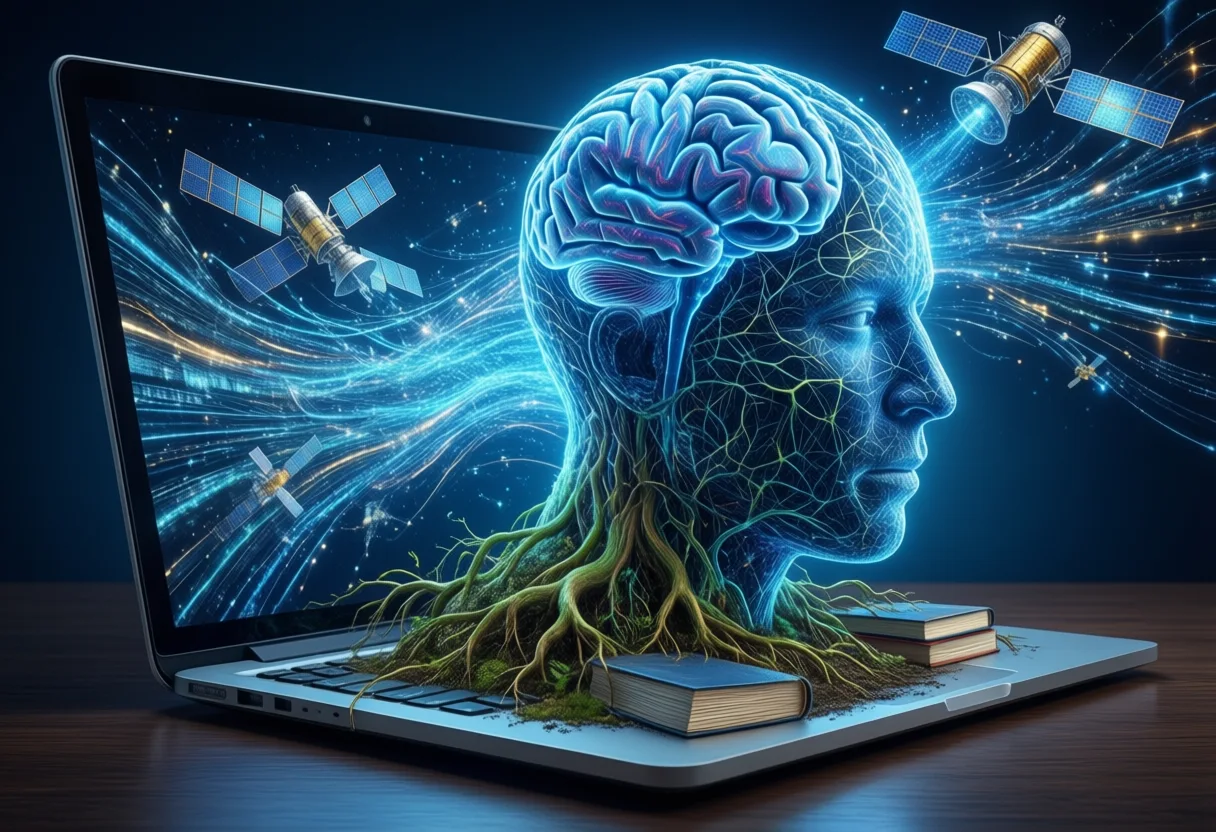
The future of knowledge is no longer locked behind paywalls or confined to ivy-covered laboratories-it pulses through open-access algorithms, whispering insights to anyone with a connection and curiosity. Across continents, students dissect genomes using the same neural networks that power pharmaceutical breakthroughs, while independent researchers simulate climate models once reserved for supercomputing elites. This quiet revolution isn’t fueled by exclusivity, but by Artificial Intelligence online Free Platforms that democratize discovery, turning every laptop into a potential portal of innovation.
These tools do not replace rigor-they amplify it. Like a microscope for the mind, Artificial intelligence Clarifies patterns in data oceans, accelerates hypothesis testing, and surfaces connections invisible to the unaided eye. And now, they’re accessible not just to institutions, but to autodidacts, educators, and dreamers probing the edges of what’s possible.

The New Literacy: AI as Cognitive Partner
To learn in the 21st century is to collaborate with Machines Not as servants, but as partners in cognition. Artificial intelligence no longer merely answers questions-it helps frame better ones, nudging learners toward deeper inquiry through adaptive feedback and contextual scaffolding. Platforms powered by natural language processing can parse dense academic texts, distill core arguments, and generate summaries tailored to individual reading levels, making advanced concepts approachable without sacrificing nuance.
Consider the student grappling with quantum mechanics or postcolonial theory: AI-driven tutors offer real-time explanations, rephrasing complex ideas until comprehension clicks like a synapse firing. These systems learn alongside their users, adjusting pacing and emphasis based on engagement-Transforming static Content into dynamic dialogue. For educators, this means more time mentoring and less time lecturing, shifting the classroom from transmission to transformation.
Such tools are not magic; they are built on layers of training data and algorithmic refinement, reflecting both human ingenuity and inherited bias. Their value lies not in infallibility, but in iteration-each interaction refining understanding for both user and machine. As we integrate them into learning ecosystems, we must remain vigilant, asking not only Can it do this? But Should it? And Who benefits?
Among the most powerful applications today is personalized learning path generation, where AI assesses a user’s current knowledge and maps an optimal journey forward. Whether mastering statistical inference or bioinformatics, these pathways adapt in real time, introducing challenges just beyond reach-close enough to inspire, far enough to stretch. Explore how these systems are reshaping industries in Applications of Artificial Intelligence: Top 5 Uses Today.

Accelerating Discovery in Open Research
In Research, time is often the rarest resource-months lost to literature reviews, data cleaning, or failed simulations. Artificial Intelligence Online Free tools now compress those timelines, allowing scientists to focus on insight rather than infrastructure. Natural language models can scan thousands of papers in minutes, extracting methodologies, identifying contradictions, and suggesting novel intersections between fields.
A biologist studying neurodegenerative diseases might use AI to cross-reference gene expression datasets with clinical trial outcomes, uncovering hidden correlations that spark new hypotheses. Similarly, environmental researchers can deploy machine learning models to analyze satellite imagery, tracking deforestation or glacial retreat with precision once requiring years of manual annotation. These capabilities, once confined to well-funded labs, now reside within browser tabs.
Open-source AI frameworks further level the playing field, enabling reproducibility and transparency. When code and training protocols are shared publicly, peer review evolves from static critique to collaborative refinement. Researchers in low-resource settings can replicate studies, validate findings, and contribute local data-enriching global knowledge with diverse perspectives.
Yet accessibility does not guarantee equity. The digital divide still shadows progress: unreliable internet, language barriers, and lack of technical support limit who can truly participate. Moreover, automated tools risk reinforcing dominant narratives if trained predominantly on Western-published research. True democratization requires not just access, but inclusion-designing systems that listen as much as they compute.
Tools like AI-powered citation managers, semantic search engines, and collaborative annotation platforms are quietly transforming scholarly workflows. They don’t eliminate grunt work entirely-but they redirect effort toward meaning-making, where human judgment remains irreplaceable. In this symbiosis, machines handle scale; humans provide purpose.
Beyond Automation: Cultivating Critical Engagement
The greatest danger of artificial intelligence in education and research is not replacement, but abdication-the surrender of skepticism to the allure of instant answers. When a model generates a literature review in seconds, it becomes tempting to accept its output uncritically, mistaking fluency for truth. But AI reflects probabilities, not certainties; its confidence should never substitute for scrutiny.
We must teach not just how to use these tools, but how to interrogate them. Who trained the model? What data shaped its responses? Where might it overgeneralize or omit? These questions form the foundation of a new literacy-one rooted in computational humility and epistemic vigilance. Just as we learned to evaluate sources in the age of print, we must now audit algorithms in the age of prediction.
This shift demands pedagogical reinvention. Classrooms should become spaces where students deconstruct AI outputs, comparing results across platforms, tracing provenance, and debating ethical implications. Assignments might task learners with “debugging” flawed AI-generated arguments or designing prompts that minimize bias. In doing so, they don’t just consume technology-they shape its evolution.
For researchers, the imperative is similar: embrace augmentation, not automation. Let AI draft initial analyses, but insist on human interpretation. Use it to explore vast datasets, but ground conclusions in context and causality. The goal is not efficiency at all costs, but depth with assistance-a partnership where machines extend our reach without eroding our responsibility.
As these tools mature, so too must our moral imagination. The knowledge economy should not be winner-take-all, where only the technologically fluent thrive. Instead, let us build ecosystems where artificial intelligence serves as a rising tide-lifting diverse minds, amplifying underrepresented voices, and expanding the boundaries of what any one of us can discover alone.
The revolution will not be televised. It will be coded, queried, questioned-and quietly, persistently, rewritten by those who refuse to outsource wonder.
Smarter Learning Starts Here
Tools That Think Like Tutors
Did you know some free AI tools can explain quantum physics using pizza analogies? While that’s a playful exaggeration, many online AI platforms actually adapt explanations to match your level-breaking down tough topics into bite-sized, relatable ideas. These tools don’t just spit out answers; they simulate tutoring sessions by asking follow-up questions, guiding problem-solving step by step, and even spotting where you might be misunderstanding a concept. That kind of interactive feedback used to require a human, but now it’s accessible to anyone with an internet connection.
The Brains Behind the Free Access
It might seem surprising that powerful AI tools are offered at no cost, but many are designed as educational sandboxes-places where students and researchers can experiment without financial barriers. These platforms often run on open-source models or scaled-down versions of advanced systems, letting users explore capabilities like summarizing research papers, generating study guides, or translating complex jargon into plain language. Some even help draft code or debug errors in real time, making them handy companions for learners diving into computer science or data analysis.
Surprise Uses You Haven’t Tried
Beyond homework help, free AI tools have quirky, practical uses that boost productivity. For instance, you can upload a cluttered lecture transcript and have an AI reorganize it into clear bullet points, or turn a rough research idea into a structured outline in seconds. Others help generate flashcards automatically from your notes, saving hours of prep time. And because these tools learn from vast datasets, they can suggest related concepts you might not have considered-like connecting a biology topic to a recent breakthrough in bioengineering-opening doors to deeper, more creative exploration. Explore more stories, videos, and creators on Loaded.
Frequently Asked Questions
What are Artificial Intelligence Online Free tools used for in learning?
They help explain complex topics, adapt to individual reading levels, and provide real-time tutoring through interactive feedback and personalized learning paths.
How do free AI tools support independent researchers?
They accelerate literature reviews, analyze large datasets, extract methodologies from papers, and enable access to machine learning models for tasks like satellite imagery analysis.
Can free AI tools help with study preparation?
Yes, they can reorganize lecture transcripts into bullet points, generate flashcards from notes, and turn rough ideas into structured outlines.
Are free AI tools biased or limited in any way?
Yes, they can reflect biases from training data, overgeneralize, or omit information, especially if trained mostly on Western-published research or without diverse inputs.
This article was produced with AI assistance. How Neuron Magazine uses AI.
Zahra explores the frontiers of human enhancement, from neural implants to gene editing, with a focus on ethical implications and lived experience. She blends scientific rigor with intimate storytelling to illuminate how technology reshapes identity and lifespan.