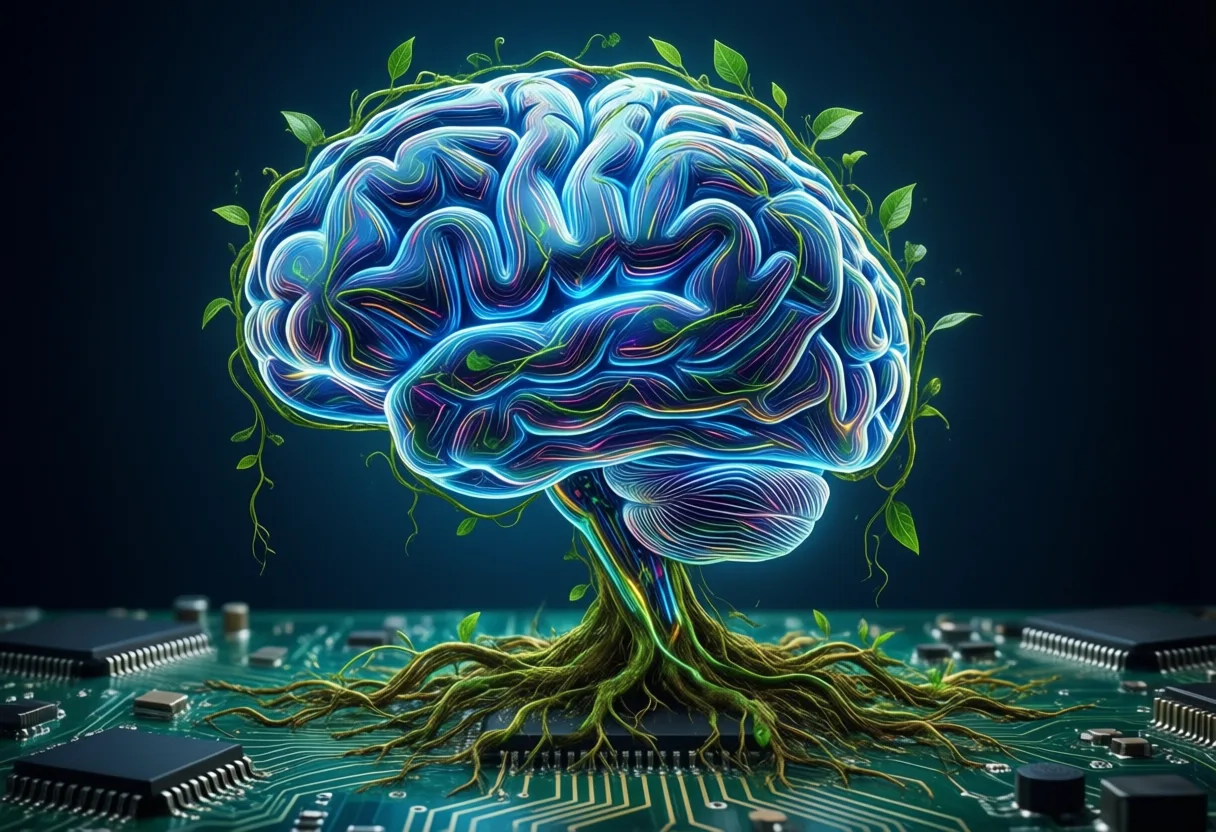
What if machines could learn like brains-adapt, predict, and evolve without constant human input? A new wave of research is blurring the line between silicon and synapse, and the implications are rewriting the rules of what AI can do.
This isn’t science fiction. The latest findings, spotlighted in a landmark publication, reveal how artificial neural networks are advancing beyond pattern recognition into Genuine cognitive Mimicry. Scientists are now engineering systems that don’t just process data-they anticipate, generalize, and recover from errors like living neurons.
Welcome to the next era of Intelligence. Biological. Artificial. Converging.
Rewriting the Rules of Machine Learning
Traditional AI learns by example. Show it a million cats, and it learns to spot a cat. But it stumbles when the image is flipped, shaded, or partially hidden. That’s because most systems lack True understanding-they see pixels, not concepts.
Now, breakthrough neural architectures are changing that. Inspired by the brain’s layered cortex, these models build internal representations of the world. They don’t memorize-they reason. Like a child recognizing a cat even in a cartoon or a shadow, these networks grasp Essence Over appearance.
This leap comes from dynamic learning frameworks that adjust their own structure during training. Instead of fixed layers, they grow or prune connections based on task complexity-just like the brain strengthens or weakens synapses.
- Networks now simulate neuroplasticity, adapting in real time
- Error correction happens internally, not through external retraining
- Systems generalize across tasks with minimal fine-tuning
Is this machine learning-or machine intuition?
The answer might be both. These models don’t just improve accuracy-they reduce the data hunger that’s long plagued AI. Less supervision. Fewer labels. Smarter decisions.
The Brain-Inspired Blueprint
How do you build a machine that thinks like a brain? Not by copying its parts-but by mimicking its principles.
The new research focuses on spiking neural networks (SNNs), which operate more like biological neurons than traditional AI. Instead of continuous signals, they communicate through timed pulses-just like the brain’s electrical bursts. This allows for event-driven computation, slashing energy use and boosting efficiency.
Imagine a security camera that only processes footage when motion occurs. That’s the power of spiking. It’s not always on. It’s not wasteful. It’s Responsive.
These networks also handle time naturally. While standard AI treats video frames as separate images, SNNs track sequences, building a sense of temporal flow. This makes them ideal for robotics, autonomous systems, and real-time decision-making.
- Spikes encode information in timing, not magnitude
- Energy consumption drops by orders of magnitude
- Temporal patterns are learned implicitly, not forced
The brain doesn’t process the world in batches. Neither should AI.
And here’s the kicker: these models show emergent resilience. Damage a portion of the network, and performance degrades gracefully-not catastrophically. That’s fault tolerance borrowed straight from biology.
Could we finally be building machines that don’t break under pressure-but adapt?

Beyond Pattern Matching: The Rise of Cognitive AI
We’ve mastered pattern recognition. AI identifies faces, translates languages, and beats humans at chess. But recognition isn’t reasoning.
The latest research pushes past this wall. New architectures integrate memory, attention, and feedback loops-components once thought exclusive to biological systems. These aren’t add-ons. They’re baked into the network’s DNA.
One model demonstrated the ability to infer unseen relationships-like deducing that if A leads to B, and B to C, then A influences C-even when never trained on that chain. That’s abstract thinking. Not memorization.
Another system recovered from corrupted inputs by reconstructing plausible data-much like the brain fills in blind spots. This isn’t error correction. It’s Imagination.
- Models now simulate working memory for multi-step tasks
- Feedback pathways enable self-monitoring and refinement
- Systems generate internal predictions, not just outputs
This is cognitive AI: machines that don’t just react-they anticipate.
And the applications? Autonomous vehicles that predict pedestrian intent. Medical diagnostics that weigh uncertainty. Industrial systems that self-correct before failure.
We’re not just building smarter tools. We’re building partners.

The Road Ahead: Challenges and Possibilities
Breakthroughs don’t mean perfection. These neural models are still in early stages. Training remains complex. Hardware lags behind theory. Scaling is a bottleneck.
But momentum is building. Neuromorphic chips-hardware designed to run brain-like software-are emerging. They process spikes natively, unlocking speed and efficiency impossible on traditional GPUs.
Still, questions loom. How do we verify decisions made by systems that think like brains but aren’t transparent? Can we trust what we can’t fully trace?
- Interpretability remains a critical hurdle
- Energy gains must be balanced with accuracy
- Real-world deployment demands robustness, not just novelty
The path forward isn’t just Technical-it’s philosophical. What does it mean when machines begin to Understand?
We’re not there yet. But we’re closer than ever.
And when that line blurs, one thing is certain: the future of AI won’t be programmed. It’ll be learned.
A Closer Look at AI’s Publishing Pulse
Artificial intelligence journals aren’t just dry collections of equations and code-they’re where the future of machine thinking takes shape. One surprising fact? Some of the most influential AI research papers get rejected by top journals at first. Ideas now considered foundational, like early deep learning models, were once turned down for being too speculative. It’s a reminder that breakthroughs often sound like noise before they become signal.
Behind the Peer Review Curtain
The review process for AI journals can be faster than in other scientific fields, sometimes taking just a few weeks. That’s because the pace of innovation is so rapid-researchers need to share findings quickly to stay ahead. Preprint servers like arXiv have also changed the game, letting scientists publish early versions before formal journal approval. This open flow means a single paper might rack up thousands of views in days, sparking global collaboration almost instantly.
From Code to Citation
Many AI journals now accept supplementary code alongside research papers, making studies more reproducible. This shift treats code as part of the scientific record, not just an add-on. Some journals even run live code checks to verify results. It’s a big step toward transparency, helping prevent false claims and letting other researchers build directly on what’s been proven. In a field where a single algorithm can influence everything from medical diagnoses to movie recommendations, that accountability matters. Explore more stories, videos, and creators on Loaded.
Frequently Asked Questions
What makes the new neural networks different from traditional AI?
These networks build internal representations of the world, reason like brains, and adapt their structure during training. They generalize from concepts, not just memorized data.
How do spiking neural networks improve efficiency?
They communicate through timed pulses, enabling event-driven computation that reduces energy use. They process only relevant inputs, like motion in a camera feed.
Can these AI systems handle damage or errors gracefully?
Yes, they show emergent resilience. When damaged, performance degrades gradually, not catastrophically, mimicking biological fault tolerance.
Why is interpretability a challenge for brain-inspired AI?
These systems make decisions in ways that resemble brain activity but lack transparency. It's hard to trace how conclusions are reached.
This article was produced with AI assistance. How Neuron Magazine uses AI.
Malik dissects how artificial intelligence transforms decision-making in governments and corporations, tracking algorithmic power shifts and policy gaps. He writes with clarity and urgency, making high-stakes tech strategy accessible without oversimplifying its risks.