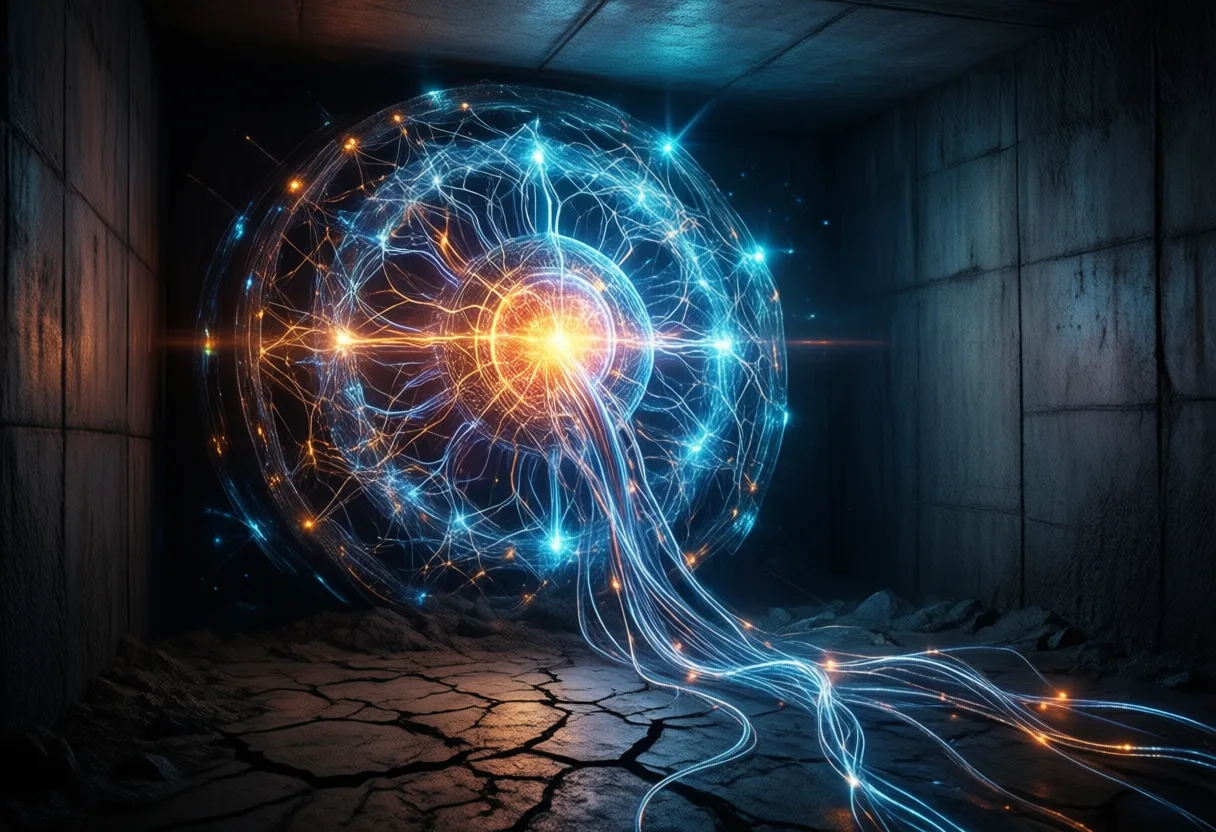
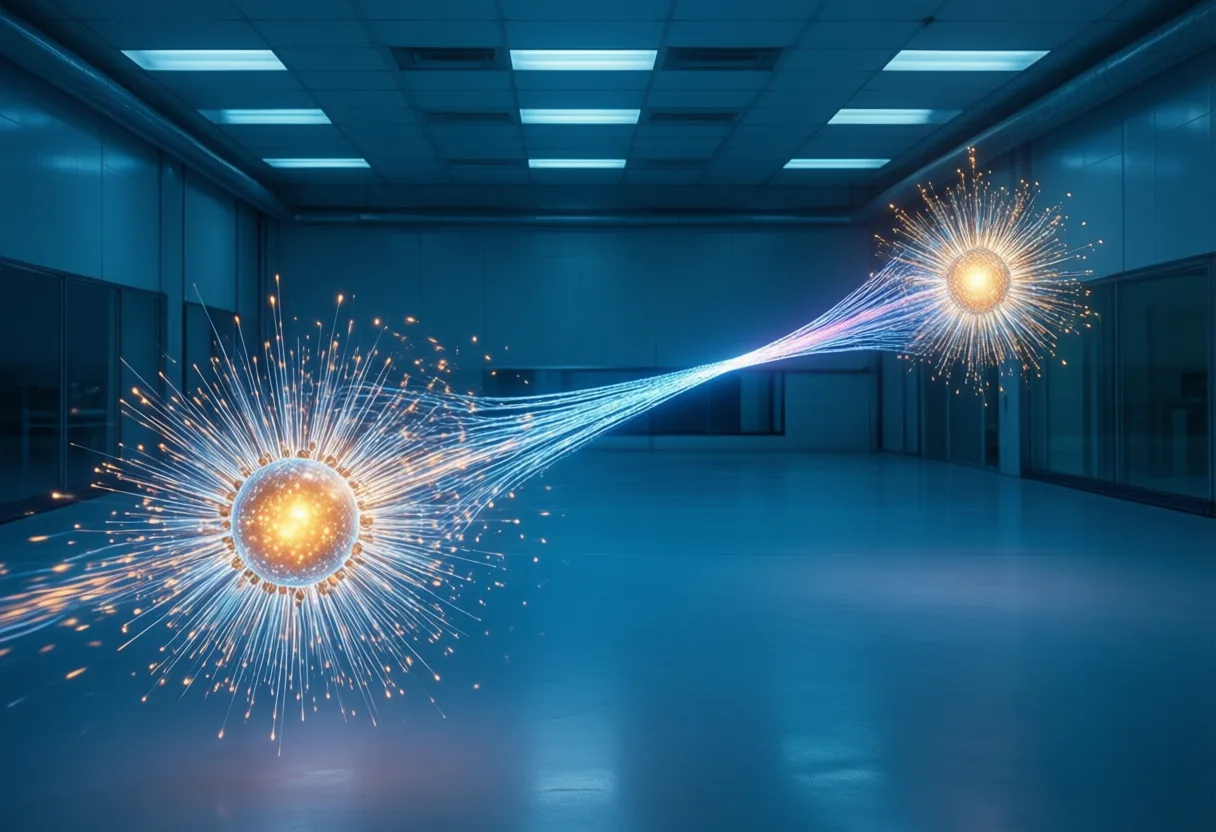
It’s not every day that the universe decides to whisper one of its oldest secrets a little louder. But recently, in quiet labs where lasers hum and atoms are cooled to near stillness, something shifted. A new chapter in Quantum entanglement Has begun-not with a bang, but with the subtle click of detectors registering particles that, despite being miles apart, still seem to know each other’s every move.
This isn’t science fiction. It’s Science news Physics, unfolding in real time, and it’s rewriting how we think about connection itself.

The Ghostly Link That Just Got Stronger
Quantum entanglement has always sounded like magic dressed in equations. Two particles, born from the same event, fly apart-across a room, across continents-and yet, measuring one instantly determines the state of the other. Einstein famously called it “spooky action at a distance.” For decades, it was a curiosity, a quirk of quantum theory that made physicists scratch their heads but didn’t do much else.
Now, that’s changing. Researchers Have not only confirmed entanglement over longer distances than ever before, but they’ve also held it steady, protected from the noise of the real world. Stability is the new breakthrough-not just creating entangled pairs, but keeping them entangled long enough to be useful.
Imagine sending a message where the act of reading it changes its content-unless you and the recipient share a quantum key, forged from entangled particles. That’s the promise. And now, with improved isolation techniques and smarter error correction, that promise is creeping closer to reality.
- Entangled photons have been transmitted through fiber networks spanning cities.
- Satellite-based experiments have linked ground stations over hundreds of kilometers.
- New materials are helping preserve quantum states longer than previously possible.
We’re not just observing entanglement anymore. We’re learning how to Tend To it-like gardeners nurturing a fragile bloom in a storm.

Why This Changes Everything (And Not Just for Physicists)
You might think quantum entanglement is only for lab coats and chalkboards. But peek behind the curtain, and you’ll see engineers, cryptographers, even city planners starting to take notes. The implications stretch far beyond theory-into how we Secure data, how we build computers, and how we might one day communicate across the solar system.
Take encryption. Today’s digital security relies on math problems so hard that even supercomputers take years to crack. But quantum computers could solve them in minutes. That’s a threat-unless we use quantum entanglement to build unbreakable encryption. A message encoded in entangled particles can’t be intercepted without leaving a trace. The moment someone eavesdrops, the entanglement breaks. You know you’ve been hacked-before the hacker even sees the data.
And then there’s quantum computing. Traditional computers use bits-ones and zeros. Quantum computers use qubits, which can be both one and zero at the same time. But to scale them up, you need entanglement. Entanglement is the glue that holds quantum computation together. Without it, you just have a very expensive calculator.
- Secure quantum networks are already being tested in metropolitan areas.
- Quantum sensors, using entanglement, can detect tiny shifts in gravity or magnetic fields.
- Future telescopes might use entangled photons to see deeper into space with unprecedented clarity.
This isn’t just about faster internet or better spies. It’s about redefining what’s possible when we stop treating particles as isolated dots-and start seeing them as part of a deeply connected web.

The Human Side of a Quantum Revolution
I once watched a physicist demonstrate entanglement using two small LED lights. “When one blinks red,” she said, “the other will too-no matter where it is.” A child in the front row asked, “Even if it’s on the Moon?” She smiled. “Even if it’s on the Moon.”
That moment stuck with me. Because behind every equation, every cryogenic chamber, every fiber-optic spool, there’s a human hunger to understand connection. We build machines to test entanglement because, in a way, we’re searching for it ourselves-faster, deeper, more certain links in a world that often feels fragmented.
And maybe that’s the quiet power of this breakthrough. It’s not just that particles can stay linked across space. It’s that we’re finally learning how to preserve those links-how to protect them from interference, how to measure them without breaking them, how to use them without losing them.
We’re learning, in other words, what it takes to keep something fragile alive in a noisy world.
So the next time your video call glitches or your password feels flimsy, remember: somewhere, in a lab with more mirrors than a funhouse, two particles are whispering across the dark. And thanks to the latest in science news physics, we’re finally learning how to listen.
Quantum Entanglement: Stranger Than Fiction
Spooky Action Gets Real
Quantum entanglement sounds like something out of a sci-fi movie-two particles linked across space so that what happens to one instantly affects the other, no matter the distance. Einstein famously called it "spooky action at a distance," skeptical that nature could work this way. But decades of experiments have proven it’s not just theory; it’s how the universe actually operates. Scientists have entangled particles over hundreds of kilometers, even beaming them between satellites and ground stations, showing the effect holds true across vast stretches of space.
Entanglement Isn’t Just for Photons
While light particles (photons) are common in entanglement experiments, researchers have stretched the phenomenon to much larger systems. Atoms, electrons, and even tiny vibrating drums visible under a microscope have been successfully entangled. One team managed to entangle two aluminum drums, each about the width of a human hair-huge by quantum standards. These experiments push the boundary of where quantum effects apply, hinting that the line between the quantum and everyday worlds might be blurrier than once thought.
A Key to Future Tech
Entanglement isn’t just a curiosity-it’s the backbone of emerging technologies. Quantum computers use entangled qubits to perform calculations far beyond classical machines. Quantum networks rely on entanglement for ultra-secure communication, where any eavesdropping attempt would disrupt the link and alert users. Recent breakthroughs in maintaining entanglement for longer durations and across more complex systems are accelerating progress toward real-world applications, bringing what once seemed like fantasy closer to daily life. Explore more stories, videos, and creators on Loaded.
Frequently Asked Questions
What is quantum entanglement?
Quantum entanglement is a phenomenon where two particles, once linked, instantly affect each other's state no matter how far apart they are. It is a proven feature of quantum physics, not just theoretical.
Why is the recent breakthrough in quantum entanglement significant?
The breakthrough lies in maintaining stable entanglement for longer periods and over greater distances. Researchers are now protecting entangled states from real-world interference, making practical applications more feasible.
How can quantum entanglement improve encryption?
Entanglement enables unbreakable encryption because any attempt to intercept a message disrupts the entangled state. This alerts users to eavesdropping before any data is compromised.
What technologies rely on quantum entanglement?
Quantum computing, secure quantum networks, and quantum sensors depend on entanglement. It also holds potential for advanced telescopes and communication across vast distances.
This article was produced with AI assistance. How Neuron Magazine uses AI.
Saoirse investigates how automation, remote systems, and AI reshape labor, careers, and human purpose. She centers worker voices and cultural change, blending data with narrative depth to reveal what the future feels like on the ground.