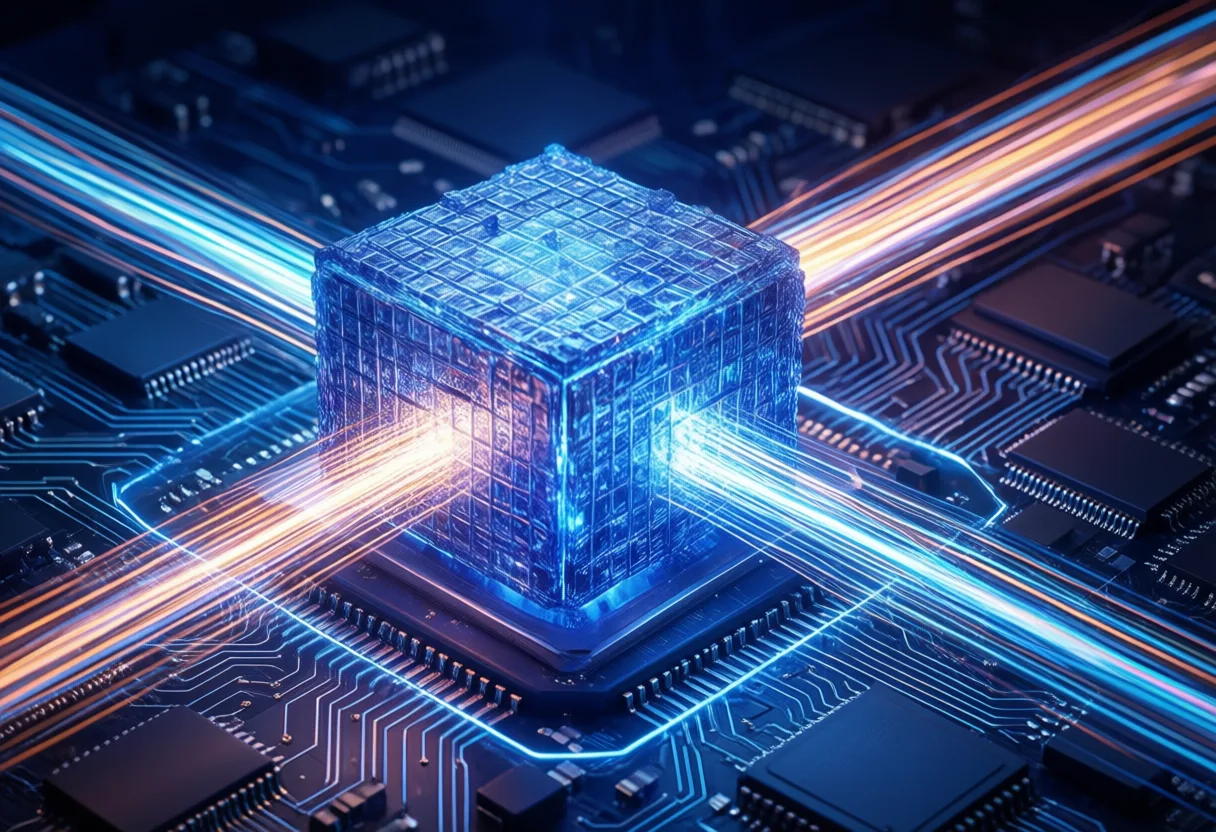
What if the fragile heart of Quantum computing-its qubit-could finally beat steadily instead of flickering out in microseconds? For years, the dream of scalable quantum machines has been held hostage by instability. Now, Qubit stability Has leapt forward, shattering old assumptions and rewriting the roadmap.
This isn’t just progress. It’s a pivot. The bottleneck that defined quantum’s infancy may no longer be the choke point it once was. And that Changes Everything.
The Race to Extend Qubit Lifespan Takes a Dramatic Turn
For over a decade, researchers fought a war against decoherence. Qubits lost their quantum state faster than a match burns out in the rain. Every calculation collapsed before completion. The race wasn’t just about adding more qubits-it was about keeping them alive long enough to matter.
Now, Coherence times Have stretched dramatically. We’re no longer measuring survival in microseconds but in milliseconds, even seconds in some cases. That’s not incremental. That’s A thousandfold leap In some experimental systems. What changed?
New isolation techniques. Cleaner materials. Smarter control pulses. The combination has created a quiet zone where quantum states can persist. Think of it like shielding a candle flame inside a hurricane-finally, the walls are holding.
This isn’t theoretical. Labs are reporting repeatable results. The signal-to-noise ratio is shifting. And for the first time, error rates are dipping below thresholds once thought unreachable. The finish line is still far, but the track just got flatter.

Not All Qubits Are Created Equal: Material Breakthroughs Reshape the Landscape
Superconducting loops. Trapped ions. Topological states. Silicon spin qubits. The quantum zoo is crowded. But not every platform responds the same to stability upgrades. Some architectures are now pulling ahead-fast.
Why? Material purity. Defects in substrates used to be invisible killers. Now, atomic-level engineering has slashed impurities. Silicon-28 enrichment, for example, reduces magnetic noise. Cleaner crystals mean quieter qubits. And quiet Qubits last Longer.
Trapped ions benefit from ultra-high vacuum and laser precision. Their coherence was always strong-but scaling was the issue. Now, with better trap designs and photonic interconnects, they’re not just stable, they’re becoming practical.
Meanwhile, superconducting qubits are getting smarter. Not just colder. Dynamic error suppression, real-time feedback, and tunable couplings are turning them from delicate lab toys into robust computational units. The hardware isn’t just improving-it’s Learning.
Error Correction Just Got Easier-Here’s What Changed Under the Hood
Quantum error correction has always been a numbers game. You need many physical qubits to protect one logical qubit. The worse the noise, the more overhead. It was a vicious cycle: unstable qubits demanded more correction, which demanded more qubits, which introduced more noise.
But now? Higher coherence means lower error rates. And lower error rates mean fewer physical qubits per logical one. The math just got kinder. Suddenly, a 1,000-qubit machine might actually deliver hundreds of usable logical qubits-not just a handful.
New codes are also emerging. Tailored to specific hardware noise profiles. Not one-size-fits-all. Adaptive. Self-correcting. These aren’t just theoretical-they’re being tested on real devices with real results.
And control systems are smarter. Machine learning optimizes pulse shapes in real time. Noise is predicted, not just reacted to. The system doesn’t just run-it listens, adjusts, and stabilizes. It’s like a self-driving car for quantum states.

Beyond Lab Curiosity: Real-World Applications Edge Closer to Feasibility
Drug discovery. Materials design. Financial modeling. Optimization at scale. These were the promised lands-always “ten years away.” But with stable qubits, the horizon is bending closer.
Simulating complex molecules used to fail because the quantum state collapsed mid-calculation. Now, simulations run to completion. Accuracy improves. Confidence grows. We’re not just guessing-we’re verifying.
Logistics networks. Supply chains. Traffic flows. These are combinatorial nightmares for classical computers. But with longer coherence, quantum algorithms can explore more paths, find better solutions, and do it faster.
Even cryptography is shifting. Not because we have a working quantum hacker yet-but because the foundation for one is solidifying. The threat isn’t hypothetical. It’s becoming engineering.
Misconceptions About Quantum Readiness Collapse Overnight
“Quantum computers will never be practical.” “They’re too noisy. Too fragile.” “It’s all hype.” These arguments had weight-until now.
Stability wasn’t the only problem. But it was the anchor. Remove it, and the entire system accelerates. Skepticism based on past limitations no longer applies. The rules have changed.
We’re not saying quantum laptops are coming next year. But the idea that quantum machines can’t outperform classical ones in specific domains? That’s crumbling.
This isn’t about replacing your laptop. It’s about solving problems we’ve never touched. Problems that matter. And now, the tools are starting to hold together long enough to try.

What This Means for Industry Timelines and Investment Strategies
Venture capital was cautious. Corporations moved slowly. Why bet big on a technology that couldn’t finish a calculation? But now, the risk profile is shifting.
Startups with stability-focused architectures are attracting serious attention. Not just funding-partnerships. Automotive, pharma, energy sectors are stepping in. They’re not just watching. They’re building pipelines.
Timelines are compressing. Roadmaps that assumed five more years of struggle now look outdated. Some milestones may arrive twice as fast. The inflection point is here.
And talent? It’s migrating. Researchers are pivoting. The hottest problems are no longer about brute-force scaling-but about integration, control, and application. The race has entered a new phase.
The Stability Milestone That Changes Everything Going Forward
Let’s be clear: this isn’t the end of the journey. It’s the moment the terrain shifts. Qubit stability Was the wall. Now, we’ve breached it.
The next challenges? Scaling with fidelity. Building software that leverages longer coherence. Creating systems that don’t just work-but work reliably.
But for the first time, the core physics seems to be on our side. The universe isn’t fighting us as hard. We’re learning to listen to its rules-and bend them, just enough.
The era of unstable, fleeting quantum states is fading. What comes next isn’t just faster computation. It’s a new way of thinking. And it’s already beginning.
Why Qubit Stability Is a Game-Changer
The Delicate Dance of Quantum Bits
Quantum computers don’t run on ordinary ones and zeros. Instead, they use qubits, which can be both one and zero at the same time-a weird quirk called superposition. But keeping that state is tough. Even tiny vibrations or temperature shifts can make qubits lose their data in a flash, a problem known as decoherence. That’s why most quantum machines need to operate near absolute zero, colder than outer space.
Scientists have been chasing longer coherence times for years. Think of it like trying to keep a spinning top upright on a bumpy road. Recent progress has shown some lab-made qubits can now hold their state long enough to perform more complex calculations-some stretching into milliseconds, which may not sound like much, but in quantum terms, it’s practically an eternity. This extra time lets researchers run more operations before errors pile up.
Another cool twist? Some teams are using trapped ions or superconducting circuits, while others experiment with topological qubits, a design theoretically more resistant to noise. Microsoft’s approach, for example, banks on these elusive topological states, though they haven’t been definitively proven yet. Meanwhile, companies like IBM and Google keep refining their existing hardware, squeezing out more stability from every component. Every small gain means we’re one step closer to machines that could someday tackle problems today’s supercomputers can’t touch. Explore more stories, videos, and creators on Loaded.
Frequently Asked Questions
Why is qubit stability important for quantum computing?
Qubit stability allows quantum states to persist longer, enabling more complex calculations. Without it, quantum information collapses due to decoherence from environmental noise.
How have coherence times improved recently?
Coherence times have stretched from microseconds to milliseconds, and in some cases seconds. This represents a thousandfold improvement in certain experimental systems.
What technologies are helping improve qubit stability?
New isolation techniques, cleaner materials, atomic-level engineering, and smarter control pulses are enhancing stability. Dynamic error suppression and real-time feedback also play key roles.
Which qubit platforms are showing the most progress in stability?
Trapped ions, superconducting circuits, and silicon spin qubits are advancing. Trapped ions benefit from ultra-high vacuum and laser precision, while superconducting qubits use tunable couplings and error suppression.
This article was produced with AI assistance. How Neuron Magazine uses AI.
Malik dissects how artificial intelligence transforms decision-making in governments and corporations, tracking algorithmic power shifts and policy gaps. He writes with clarity and urgency, making high-stakes tech strategy accessible without oversimplifying its risks.