Imagine launching up a hill like a rocket-no pedaling, no sweat, just silent, relentless forward motion. Electric scooters Fast enough to conquer steep urban slopes are no longer niche gadgets. They’re becoming essential tools in cities built on inclines, powered by a single game-changing component: the 1000W motor.
How 1000W Motors Are Redefining Urban Commuting
Cities aren’t flat. Why Should Our rides be limited by gravity?
The shift from 250W to 1000W motors marks a turning point in personal mobility. These high-output systems deliver torque that fights inertia head-on. They don’t just maintain speed uphill-they accelerate through it.
Commuters are ditching cars for two-wheeled machines that slice through traffic and elevation with equal ease. Parking vanishes as a problem. Fuel costs drop to near zero. The daily grind becomes smoother, faster, quieter.
Is this the end of the last-mile myth? When your scooter climbs like a mountain trail runner, the “last mile” might just be the easiest part.
Why Power Matters on Inclines
Ever tried riding a weak scooter uphill? It feels like wading through syrup.
Gravity doesn’t negotiate. On a 15% grade, even a small incline can halve the speed of underpowered models. A 500W motor might stall, stutter, or simply give up. But a 1000W motor? It answers force with force.
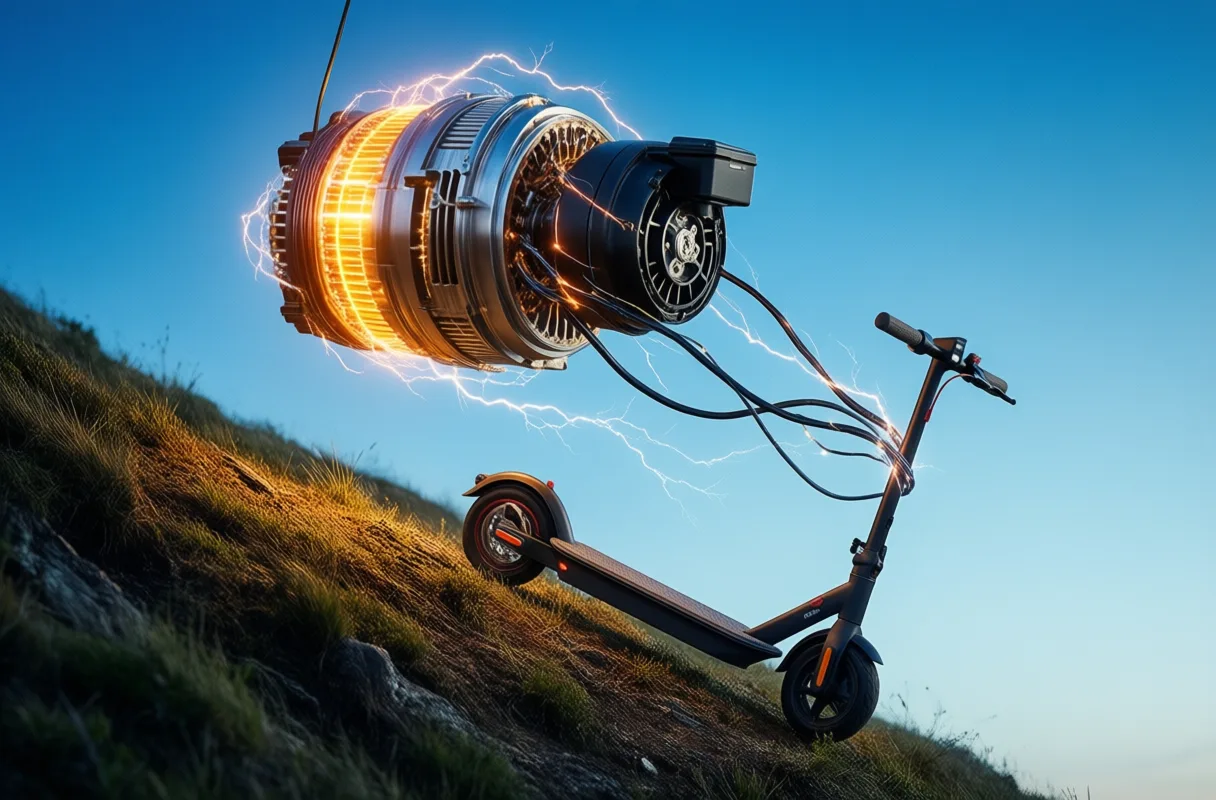
Torque is the hero here. Higher wattage means more rotational force at the wheel. That translates to immediate response when you twist the throttle. No lag. No hesitation. Just propulsion.
Think of it like horsepower in cars-but scaled down to your feet. Would you climb a mountain road in a lawnmower engine? Then why accept it in your commute?
Scooters That Climb Like Mountain Goats
Dual-motor designs built for elevation
Two motors. Double the grip. Double the confidence.
Dual 1000W setups-totaling 2000W peak output-are emerging as the gold standard for hill-heavy terrain. They distribute power evenly across both wheels, reducing slippage and increasing traction.
These systems mimic all-wheel drive in cars. When one wheel loses grip, the other compensates. On wet pavement or loose gravel, that balance is critical.
Manufacturers are no longer building scooters for flat test tracks. They’re engineering for real cities-San Francisco, Lisbon, Pittsburgh-where streets tilt like roller coasters.
Real-world performance on 20%+ gradients
On paper, specs look good. But what happens when the road pitches upward?
Scooters with 1000W motors maintain speeds of 20+ mph even on sustained 20% gradients. That’s steeper than most city streets-but exactly where performance separates contenders from pretenders.
Riders report reaching the top without dismounting. No pushing. No overheating. Just steady, controlled ascent.
This isn’t theoretical. It’s happening now, block by block, in hilly neighborhoods where convenience used to mean car dependency.
Battery demands of sustained uphill speed
Power is nothing without endurance.
Climbing hills consumes energy-fast. A 1000W motor running at full tilt can drain a battery in half the time of flat-terrain use. The steeper the hill, the harder the draw.
That’s why high-capacity lithium-ion packs are now standard on performance models. Without them, you’d run out of juice halfway up the climb.
Thermal management matters too. Continuous uphill strain heats motors and batteries. Smart systems now include cooling protocols to prevent shutdowns. Heat isn’t just uncomfortable-it’s a performance killer.
Debunking the Flat-Terrain Myth
We’ve been sold a lie: that Electric scooters Are only for flat, smooth paths.
That idea was born in the early days of low-wattage, lightweight models built for college campuses and bike lanes. They worked-on paper. But real cities aren’t campuses.
Today’s 1000W scooters shatter that limitation. They’re not just surviving hills-they dominating them.
The myth persists because many scooters Are Underpowered. But that doesn’t mean the category is flawed. It means we’ve been selling it short.
Engineering Behind the Thrill
This isn’t magic. It’s physics, refined.
The 1000W motor generates rotational force through tightly wound copper coils and powerful magnets. When current flows, the rotor spins-hard and fast.
Controllers regulate power delivery, preventing surges that could fry circuits or spin wheels. They act like a brain, interpreting throttle input and adjusting output in milliseconds.
Frame geometry has evolved too. Lower centers of gravity improve stability. Reinforced suspensions absorb shock. Tires are wider, grippier, built for grip on inclines.
Every piece is tuned for one goal: Defy gravity without breaking a sweat.
What Riders Should Know Before Buying
Not all 1000W motors are created equal.
Peak wattage can be misleading. Some brands advertise “1000W” as a burst rating, not continuous output. Look for sustained power ratings-those tell the real story.
Weight matters. High-power scooters are heavier. That’s the trade-off for durability and battery size. Can you carry it up stairs? Fold it into a trunk?
Check local laws. Many regions classify anything over 750W as a moped. That means registration, insurance, maybe even a license. Don’t get caught off guard.
And always test ride. Specs don’t capture how a scooter Feels When the road tilts skyward.
The Future Is Uphill – And Electric
The next frontier isn’t speed. It’s elevation.
Cities will keep growing vertically-not just in skyscrapers, but in terrain. As urban sprawl climbs into hillsides, transportation must follow.
1000W scooters are the first wave. Soon, we’ll see adaptive AI systems that predict inclines and optimize power use. Regenerative braking will recharge batteries on the descent.
The future isn’t just electric. It’s relentless. It’s climbing. It’s moving upward-on two wheels, with silent power, and no limits.
The hill is no longer a barrier. It’s an invitation.
| Feature | Purpose |
|---|---|
| 1000W motor | Delivers high torque for steep hill climbs |
| Dual-motor setup | Improves traction and balance on inclines |
| High-capacity battery | Supports energy demands during sustained climbs |
| Thermal management | Prevents overheating under continuous strain |
| Reinforced suspension | Absorbs shock on rough or steep terrain |
| Wider, grippier tires | Enhances control and stability uphill |
| Smart controllers | Regulate power delivery for smooth acceleration |
Zooming Up Hills: The Power Behind Steep Rides
Why 1000W Motors Dominate Inclines
Ever seen an electric scooter climb a hill like it’s nothing? A 1000W motor is often the muscle behind that feat. While many scooters top out around 500W, doubling the power makes a real difference when gravity fights back. These stronger motors generate more torque, which is what you need to get moving uphill without slowing to a crawl. It’s not just about speed on flat ground-it’s about maintaining momentum when the pavement starts to rise.
Real-World Punch, Not Just Paper Stats
A scooter with a 1000W motor doesn’t just sound impressive on paper-it changes how you ride. Some models can tackle inclines up to 20% or more, which is steeper than most city streets. That extra power also helps when carrying heavier loads or battling wind. And while top speeds often hover around 30-40 mph for these scooters, the real thrill is how smoothly they handle tough terrain. Riders notice less strain on the motor and fewer moments where the scooter feels like it’s about to give up.
Built Tough for the Climb
High-wattage scooters aren’t just about the motor. They usually come with beefier batteries to keep up with the energy demand, plus stronger brakes and suspension to handle faster descents. Some even feature dual motors-one on each wheel-for better traction and balance on slippery or uneven slopes. So when you’re flying up a hill, it’s not just raw power at work. It’s a full system designed to handle the push, the weight, and the speed, all without skipping a beat. Explore more stories, videos, and creators on Loaded.
Frequently Asked Questions
Why are 1000W motors better for hills?
1000W motors generate more torque, allowing scooters to maintain speed and accelerate uphill without stalling or slowing to a crawl.
Can electric scooters handle steep city inclines?
Yes, scooters with 1000W motors can tackle sustained 20% gradients, common in hilly cities like San Francisco and Pittsburgh.
Do high-power scooters need special batteries?
Yes, high-capacity lithium-ion batteries are standard to meet the energy demands of sustained uphill riding and prevent premature drain.
Are 1000W scooters legal everywhere?
No, many regions classify scooters over 750W as mopeds, requiring registration, insurance, or a license.
This article was produced with AI assistance. How Neuron Magazine uses AI.
Malik dissects how artificial intelligence transforms decision-making in governments and corporations, tracking algorithmic power shifts and policy gaps. He writes with clarity and urgency, making high-stakes tech strategy accessible without oversimplifying its risks.