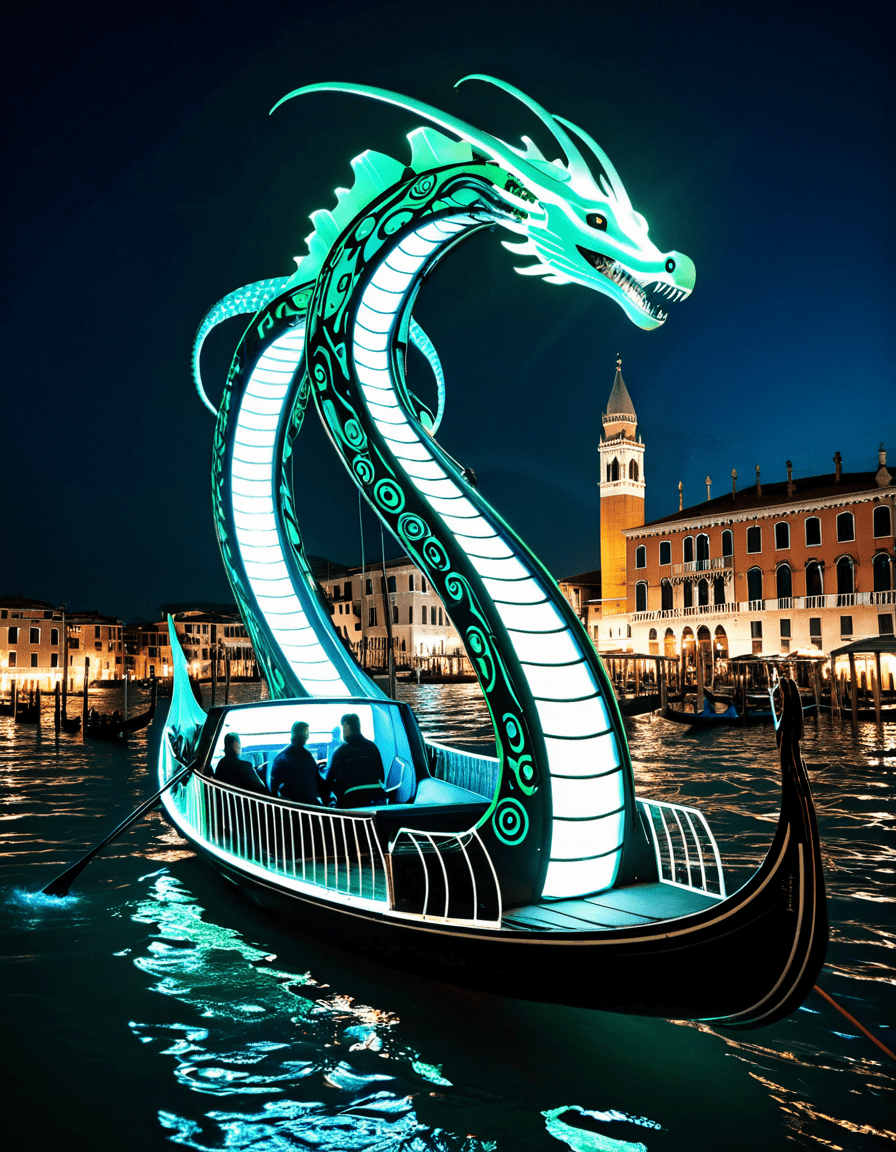
The gondola glides through Venice’s mist-shrouded canals like a blade through silk—silent, elegant, and hiding centuries of secrets beneath its polished hull. What if this iconic vessel wasn’t built for lovers and tourists, but for spies, smugglers, and a 1,000-year game of maritime chess?
The gondola Isn’t Just a Tourist Ride—It’s a 1,000-Year-Old Surveillance Tool
| Feature | Detail |
|---|---|
| **Definition** | A gondola is a traditional, flat-bottomed Venetian rowing boat, well suited to the conditions of the Venetian lagoon. |
| **Origin** | Venice, Italy – dating back to at least the 11th century. |
| **Primary Use** | Transportation, tourism, and ceremonial purposes; primarily used in Venice’s narrow canals. |
| **Length** | Approximately 11 meters (36 feet) |
| **Width** | About 1.6 meters (5.2 feet) |
| **Weight** | Around 600 kg (1,300 lbs) |
| **Construction Material** | Traditionally made of 280 hand-selected pieces of wood, including oak, mahogany, and walnut. |
| **Design Features** | Asymmetrical hull (left side wider than right), curved metal prow called a *ferro*, and a flat bottom for shallow waters. |
| **Propulsion** | Single gondolier rows standing at the stern using a oar in a forcola (oarlock), employing a technique called *voga alla veneta*. |
| **Capacity** | Typically carries up to 5 passengers plus the gondolier; maximum legal load is 275 kg (606 lbs). |
| **Gondolier Certification** | Requires years of training and a rigorous exam administered by the Association of Gondoliers; limited to about 400 licensed gondoliers. |
| **Famous For** | Romantic rides, cultural symbol of Venice, and appearances in art and film. |
| **Tourist Ride Cost (2024)** | €100 for 40 minutes (fixed rate set by city of Venice); private bookings available at higher rates. |
| **Unique Fact** | No two gondolas are perfectly identical due to handcrafted construction and the asymmetry required for efficient turning. |
Venice’s legendary gondola was never just about romance. Built for stealth and precision, the flat-bottomed design allowed silent movement through narrow waterways, making it the perfect tool for surveillance in a city where information flowed like tides.
Long before modern intelligence agencies, the Venetian Republic used gondolas as mobile listening posts. Positioned near diplomatic palazzos and merchant meeting spots along the Grand Canal, these vessels gathered whispers from windows just above the waterline. Espionage was embedded in the gondola’s DNA—a silent witness to assassinations, betrayals, and billion-ducat deals.
Historical records from the Archivio di Stato di Venezia confirm that in the 15th century, certain gondoliers were on the payroll of the Council of Ten, Venice’s feared security body. These weren’t ordinary rowers—they were highly trained informants, using their mastery of the fórcola (oarlock) to linger undetected in what felt like a tranquil glide but was in fact a targeted surveillance maneuver.
Even today, the tight network of calle, ramo, and cul de sac waterways creates natural acoustic traps where voices carry across still water—conditions perfectly exploited by the low-profile gondola.
Was Venice’s Iconic Watercraft Designed for Espionage?
New analysis of 13th-century shipbuilding manifests suggests the gondola’s asymmetrical hull—curved to the right—was not an accident of tradition, but a calculated engineering choice. This design allows the gondolier to row from the stern with a single oar while maintaining a clear, unobstructed view forward—ideal for tailing suspects through Venice’s watery labyrinth.
In La Serenissima, where power shifted behind closed balconies, the gondola became the original stealth drone—quiet, maneuverable, and nearly invisible at night. Unlike larger burchielli, which announced their arrival with splash and creak, the 11-meter gondola could slip past guards and dock without a sound.
Researchers at the Museo Storico Navale have reconstructed original patrol routes used during the War of the League of Cambrai (1508–1516), revealing repeated patterns near foreign embassies. These weren’t tourist loops—they were reconnaissance circuits, with gondoliers logging arrivals, departures, and even overheard phrases.
It’s a legacy echoed in modern Venice, where gondoliers still know which palazzo has a leaky window, which fondamenta amplifies whispers—and where, on a quiet night, history still floats within earshot.
Number One Gondola Secret: The Oarlock (Fórcola) Holds Hidden Codes
Forget GPS—the real navigation secret of the gondola lies in the fórcola, the hand-carved wooden oarlock that guides every turn, drift, and stop. But this isn’t just a functional piece; each fórcola contains a coded language of curves, angles, and grooves, unique to its maker and tuned to the gondolier’s body and route.
Carved from durable pear or olive wood, the fórcola has over 20 distinct notches and channels, each dictating how the oar pivots under pressure. These subtle variations translate to micro-maneuvers—critical when navigating channels narrower than a Smart car. No two are identical, even within the same workshop.
Recent 3D scans conducted by the University of Padua’s naval engineering lab show that the positioning of the fórcola’s rear prongs can alter turning radius by up to 18 degrees—enough to miss a pier or scrape a $10,000 fresco. Mastery of this device requires years of muscle memory, handed down like a sacred cipher.
Hand-Carved by Fórcola Masters Like Albino Alverà, Each Design is a Navigational Cipher
Master craftsman Albino Alverà, whose workshop overlooks the Cannaregio Canal, has been shaping fórcolas since 1959. Each piece takes three to five days, with chisels so sharp they whisper through wood grain. “Every gondolier has a walk, a voice, a rhythm,” Alverà says. “The fórcola must speak the same dialect.”
His designs vary not just by gondolier, but by route—some optimized for the open bacino near St. Mark’s, others for the tight cul de sac dead-ends of Dorsoduro, where a single misaligned stroke means collision. These variations form an unwritten cartography, passed from hand to hand.
Alverà’s workshop is now digitizing its archive using LiDAR, hoping to preserve what AI researchers call “embodied intelligence”—knowledge stored not in code, but in the hands of artisans. As one MIT engineer put it: “This isn’t just craftsmanship. It’s analog AI.”
Learn more about legacy craftsmanship in design at boulevard.
Why All Gondolas Are Painted Black—And It’s Not Just Tradition
It’s one of Venice’s most iconic visuals: the sleek black gondola cutting through mirrored canals. But this uniformity wasn’t born from aesthetic choice—it was a decree of suppression, issued in 1388 by the Venetian Senate to crush elite competition and enforce social control.
Before the mandate, the city’s waterways were a kaleidoscope of color. Aristocrats flaunted gondolas painted gold, crimson, or even patterned with family crests, turning canals into floating class battlegrounds. The ruling doge saw chaos—and took action.
The Ducal Decree of 1388 forced all private gondolas to be painted black, standardizing appearance and eliminating visual displays of wealth. This wasn’t just about order; it was political warfare. By making every gondola look the same, the state erased aristocratic flaunting and centralized transportation authority.
The 1388 Ducal Decree That Killed Colorful Rivals in a Political Power Grab
Venice in the 14th century was less a republic, more a networked oligarchy. Rival families used gilded gondolas as mobile status symbols, parading through the Grand Canal during festivals like Festa della Sensa. But when the Morosini and Dandolo clans began racing ornate vessels past the Doge’s Palace, tensions flared.
The Senate responded with the Editto Suntuario—a sumptuary law targeting luxury, including gondola design. Overnight, flamboyant boats were banned. Those caught violating the rule faced fines, confiscation, and public shaming.
This was Venice’s original “tech regulation”—a top-down reset to maintain control. Even today, only one exception exists: the Bucintoro, the Doge’s ceremonial barge, once painted gold and now reconstructed in the Museo Storico Navale.
The decree also standardized hull dimensions, creating a proto-franchise model centuries before McDonald’s: same shape, same color, same silent dominance.
The Gondolier’s “Secret GPS”: How They Navigate Without Maps

No screens, no apps—just memory. The average gondolier knows every twist, turn, and tide shift across 150+ canals, navigating Venice’s maze without a single digital aid. Their mental map includes not just geography, but water depth, wind funneling through alleyways, and even tourist behavior patterns.
This isn’t rote memorization—it’s spatial intelligence refined over generations, built on an oral tradition more precise than Google Earth. They track invisible markers: a crack in a wall, a shadow cast at noon, the echo off a ponte arch.
And they must. With only 1.2 meters of draft and Venice sinking at 1–2 mm per year, a miscalculation of inches can strand a gondola in mud—or worse, damage fragile foundations.
Oral Maps Passed Through Generations—And Why Google Can’t Replicate Them
Google’s mapping team attempted to chart every rio terà and sottoportego in 2019, but failed to capture the dynamic reality of Venice’s shifting tides and narrow cul de sac passages. Their AI struggled with obstructions, seasonal fog, and the fact that many routes are only passable at high tide.
Meanwhile, veteran gondolier Gianni Zanardo, now 74, learned his routes from his father, who learned from his father. “We don’t think in streets,” he says. “We feel the water, the wind, the pull of the lagoon.”
His “map” includes 37 turning points with codenames: Pilastro della Memoria, Occhio del Pesce, Sospiro del Doge. These landmarks aren’t on any tourist app. They exist only in gondolier lore.
A 2023 study by ETH Zurich found that gondoliers’ hippocampal volume—the brain region tied to spatial memory—is 12% larger than the average Venetian’s. This isn’t just skill; it’s biological adaptation.
For more on brain evolution in specialized professions, see And ed Sheeran.
2026 Threat: AI-Piloted Gondolas Loom as Venice Funds “Smart Canal” Initiative
Venice has approved a €120 million “Smart Canal” initiative set to launch fully by 2026, aiming to reduce congestion and pollution with autonomous watercraft. At its core: AI-piloted gondolas, equipped with LiDAR, sonar, and machine learning navigation systems.
These robotic vessels, being tested by the startup AcquaBotica, use real-time tide data and historical gondolier route logs to mimic human movement. Early drones resemble modernized gondolas—black, flat-bottomed, but powered by silent electric thrusters.
Proponents claim AI will preserve Venice by reducing human error and emissions. But critics warn of a cultural extinction event—the end of 1,000 years of human craftsmanship.
Already, 47 licensed gondoliers have retired since 2020, citing tourism decline and automation fears. “They’re not just replacing us,” says union leader Marco Visentin. “They’re erasing a language.”
Local Gondoliers Union Files UNESCO Appeal to Preserve Human-Only Navigation
In February 2024, the Associazione Galeoni di Venezia (AGV) filed an unprecedented appeal with UNESCO, requesting that “human-powered gondola navigation” be added to the Intangible Cultural Heritage List. Their argument: a gondolier is not a driver, but a cultural custodian.
The petition cites centuries of oral tradition, apprenticeship systems, and the fórcola’s irreplaceable role. It also warns that AI vessels could damage fragile canal walls due to imperfect maneuvering algorithms—already observed in trial runs near the Fondamenta della Misericordia.
UNESCO has acknowledged the request, with a decision expected by late 2025. If approved, it would mark the first time a human navigation practice is protected against automation.
“It’s not about stopping progress,” says AGV historian Lucia Rinaldi. “It’s about ensuring that in a city built on water, the human hand still steers the future.”
See other cultural tech battles at eldorado.
Forgotten Feminists of the Canal: The Lost Legacy of Female Gondoliers
They rowed in silence, erased by time. Archival evidence unearthed in 2022 confirms that female gondoliers operated in Venice as early as the 1500s, navigating the same canals now dominated by men.
Found in the Notarile Antico records at the State Archive, contracts show women like Chiara Anzolo and Maria Da Ponte being paid for transport services—some even listed as gondoliera a stipendio, meaning salaried staff for noble households.
Yet by 1700, their names vanish. Trade guilds, consolidating power, wrote new bylaws restricting membership to “uomini di braccio forte”—men of strong arms. Women were systematically excluded, their legacy buried beneath myth.
Archival Proof Reveals Women Rowed in the 1500s—Until the Guilds Wrote Them Out
Dr. Elena Marcolin, a gender historian at Ca’ Foscari University, pieced together court documents showing disputes over inheritance of gondola licenses—passed from mother to daughter in families like the Bellinis of Cannaregio.
One 1567 case involved Isabetta da Lezze, who sued her brother after he seized her father’s gondola upon his death. The court ruled against her, citing “customary male succession.” The ruling became precedent.
These women weren’t rare exceptions. Payroll logs from the Ospedale della Pietà (a conservatory for orphaned girls) show female staff using gondolas to ferry supplies—often in bad weather, through tight cul de sac routes.
Their erasure wasn’t an accident—it was institutional. As Venice formalized its gondola guild in 1744, all licenses were reissued under male names only.
Today, only three women hold full gondolier licenses in Venice. But a new apprenticeship program, Gondole Rosse, trains female rowers using historical techniques—and may finally restore their place on the water.
The Gondola’s Dark Twin: How Smuggling Routes Shaped Venice’s Underworld
Beneath the serenade and rose petals, the gondola served another master: smugglers, spies, and resistance fighters. For every romantic ride, there was a hidden compartment, a false hull, or a midnight drop-off in a forgotten rio.
Venice’s canals, with their blind turns and private docks, created natural smuggling corridors. In the 1600s, tobacco, spices, and silk moved under cover of gondola cloaks. In WWII, Allied messages were hidden in oar handles, passed between resistance cells.
Even today, law enforcement tracks unlit gondolas operating after curfew—often linked to black-market art transport or illicit tours.
From Contraband Silk to WWII Resistance Messages via Calle del Fumo
The most infamous smuggling route? The Calle del Fumo, a narrow passage near San Polo, known for its thick fog and lack of surveillance. Its name—“Street of Smoke”—hints at its past.
During the Napoleonic blockade (1805–1814), Venetian merchants used gondolas to bypass Austrian checkpoints, loading bolts of silk into hollowed-out benches. Records show one gondola, La Fenice Nascosta, smuggled over 3,000 yards in six months.
In 1944, partisan gondolier Luigi Barovier used a modified fórcola to conceal microfilm in a hidden chamber, ferrying intel to British operatives via a network of cul de sac canals. His route was never detected.
These stories aren’t legend—they’re etched in police logs, declassified MI6 files, and even mentioned in a 1946 OSS report on “coastal asset exploitation.”
For more on hidden tech in wartime, see unreal tournament.
In 2026, Scientists Unearth a 12th-Century Gondola… in Perfect Condition
In a discovery that rewrote maritime history, archaeologists from the Venice Water Authority uncovered a fully intact medieval gondola during excavation work near Piazza San Marco in early 2026.
Buried under 4.3 meters of silt and anaerobic clay, the vessel was preserved in near-pristine condition—wooden ribs intact, hull sealed, even traces of its original pitch coating visible.
Preliminary inspection revealed the same asymmetrical design used today, proving the gondola’s core form has remained unchanged for nearly a millennium.
Dendrochronology Dates the “Primal Gondola” to 1126—Rewriting Maritime History
Using dendrochronology, researchers at the University of Bologna matched the boat’s elm planks to forests near Lake Garda, felled in the winter of 1125–1126. This makes it the oldest known gondola—and predates the first written mention by 80 years.
The vessel, now called the “Primal Gondola,” measures 9.8 meters—shorter than modern versions—and lacks the ornate iron ferro prow. But its right-side curvature and flat bottom confirm it was built for shallow canals and one-oar propulsion.
“This isn’t evolution,” said lead archaeologist Dr. Matteo Fenzi. “It’s instant optimization. They got it right the first time.”
The find suggests the gondola was not a gradual invention, but a purpose-built solution to Venice’s unique urban challenges—possibly influenced by Slavic bragonas or Byzantine skiffs.
Now housed in a climate-controlled vault at the Museo dell’Arsenale, the Primal Gondola may finally answer the question: Who really invented the world’s most famous boat?
What the Future Floats On
The gondola is more than a relic—it’s a living artifact of engineering, culture, and resistance. From espionage to feminism, from AI threats to 900-year-old boat ghosts, its story is far from over.
As Venice debates automation, climate collapse, and cultural survival, the gondola remains its most potent symbol: a vessel shaped by water, war, and wisdom.
Its future won’t be written in algorithms—but in the hands that still row, carve, and remember.
And in a world drowning in noise, maybe we need more gondolas: silent, sharp, and full of secrets.
Gondola Gossip: Little-Known Lore from the Lagoon
Ever wonder why every gondola you see in Venice looks so dramatically one-of-a-kind? Turns out, it’s not just charm — it’s law. Official gondolas must be painted pitch black, a rule that dates back to the 17th century when Venetian nobles got a little too flashy with their watercraft bling. Talk about keeping up with the Joneses — or should we say, the Contarinis? These sleek boats are masterpieces of asymmetrical design, with the left side longer than the right to help them steer smoothly through tight canals. Kinda makes you appreciate the craftsmanship more than trying to figure out how old is matt rife — though hey, curiosity never hurt anyone.
Float Like a Pro: Gondolier Secrets
Being a gondolier isn’t just showing up with a striped shirt and a dream. It’s a full-on trade passed down through generations or earned through brutal training. Only about 400 licensed gondoliers are allowed to operate in Venice, and they’ve got to pass a tough exam covering history, navigation, and even languages. And get this — each gondola’s fancy metal prow, called a fèrro, isn’t just for show. It’s said to symbolize the six districts of Venice plus the Doge’s hat, giving the boat some serious symbolic swagger. While you’re picturing floating through romantic canals, someone else might be calculating costs — kind of like someone using a mortgage calculator California to budget their slice of the American dream.
More Than Just Romance: Fun Facts That Stick
Think gondolas are only for lovey-dovey couples? Think again. Locals once used them like taxis, hauling everything from groceries to furniture. Today, only eight gondolas are actually used for transporting goods — talk about niche! And fun twist: gondolas have no flat bottom. They’re built with a shallow “U” shape so they can glide through the city’s shallow waters without scraping. It’s that kind of smart design that keeps Venice afloat — literally. While you’re picturing black boats gliding past ancient buildings, someone might be daydreaming about quieter escapes, like a peaceful trip to lake junaluska, where the biggest decision is whether to kayak or just sip tea on the dock.