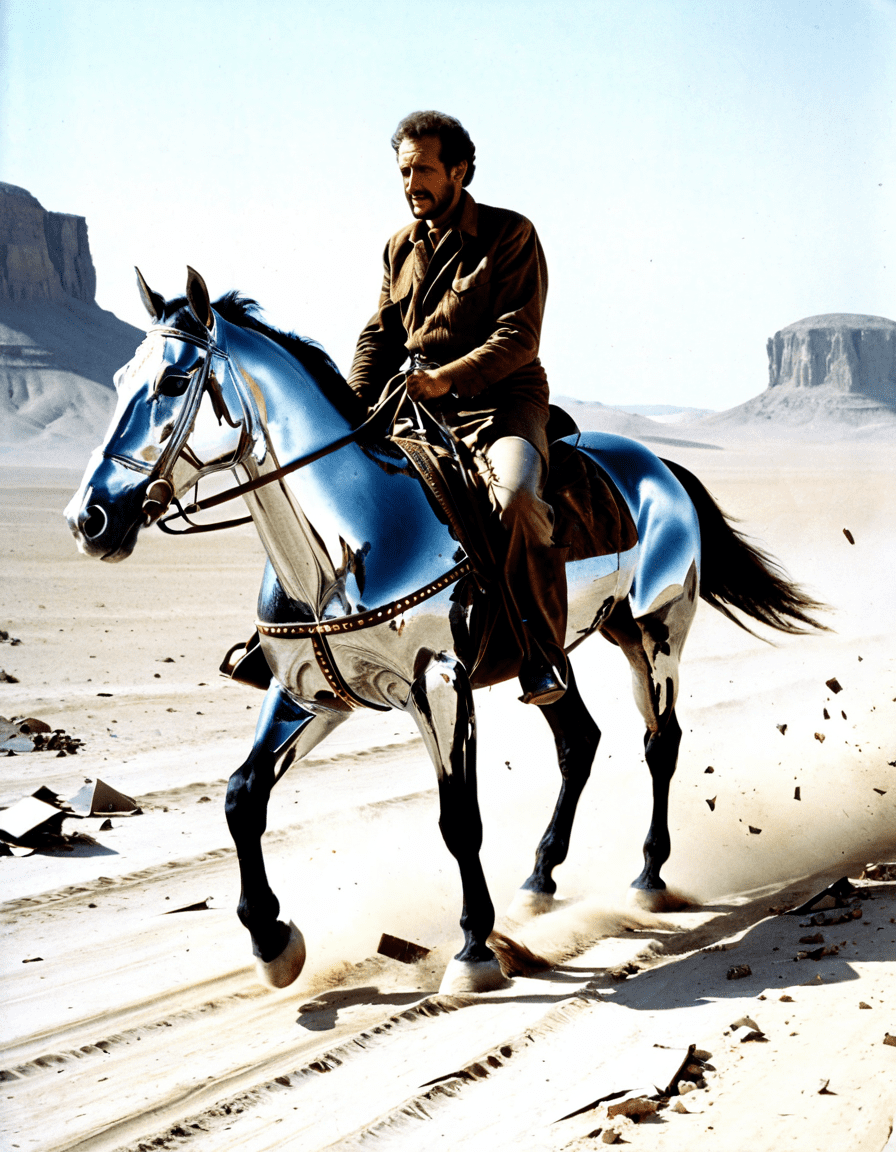
What if the most influential folk album of the 21st century wasn’t live, wasn’t modern—and wasn’t even real? O Brother, Where Art Thou? redefined American cinema not with CGI or marketing, but with cracked earth, gospel harmonies, and a script steeped in ancient myth.
| Aspect | Detail |
|---|---|
| Title | *O Brother, Where Art Thou?* |
| Release Year | 2000 |
| Directors | Joel Coen and Ethan Coen (The Coen Brothers) |
| Screenplay By | Joel & Ethan Coen |
| Based On | Loosely based on *The Odyssey* by Homer |
| Main Cast | George Clooney (Ulysses Everett McGill), John Turturro (Pete), Tim Blake Nelson (Delmar), Chris Thomas King (Tommy Johnson), Holly Hunter (Penny), John Goodman (Big Dan Teague) |
| Genre | Comedy, Adventure, Musical |
| Setting | Rural Mississippi during the Great Depression (1930s) |
| Plot Summary | Three escaped convicts—Everett, Pete, and Delmar—journey through the South in search of hidden treasure, encountering a series of eccentric characters and surreal events, while evading capture. |
| Musical Influence | Central to the film; features bluegrass, gospel, folk, and country music |
| Soundtrack | *O Brother, Where Art Thou?* soundtrack (produced by T Bone Burnett); won a Grammy for Album of the Year (2002) |
| Notable Song | “I Am a Man of Constant Sorrow” performed by George Clooney and the Soggy Bottom Boys |
| Cinematography | Pioneering use of digital color grading to create a sepia-toned, dusty 1930s aesthetic |
| Box Office | Grossed over $74 million worldwide (budget: $26 million) |
| Critical Reception | Positive; praised for its humor, music, visuals, and performances; holds 78% on Rotten Tomatoes |
| Awards | Grammy for Album of the Year (2002); César Award for Best Foreign Film; multiple other nominations |
| Legacy | Revived interest in American roots music; influenced film and music industries; cult classic status |
This Depression-era caper, framed as a Southern riff on Homer’s Odyssey, quietly engineered a cultural reset—reviving bluegrass, reshaping sound design, and exposing Hollywood’s blind spot for Black musical roots—long before streaming algorithms noticed.
o brother where art thou and the mythology machine: how Homer’s Odyssey became a Depression-era Southern odyssey
The Coen brothers didn’t just borrow from Homer—they translated his epic into the dialect of American dislocation. Set in 1937 Mississippi during the Dust Bowl, O Brother, Where Art Thou? casts Ulysses Everett McGill (George Clooney) as a modern Odysseus fleeing a chain gang, seeking treasure, redemption, and a wife who may have moved on—mirroring the hero’s 20-year journey home.
Each character aligns with an archetypal figure: Delmar O’Donnell (Tim Blake Nelson) embodies the loyal but naive companion, much like Eumaeus, while Pete (John Turturro) suffers the fate of the suitors—bound and turned into a toad by the sinister Bible salesman, a nod to the Cyclops. Even the Ku Klux Klan rally echoes the Phaeacians’ council, a grotesque assembly that masks violence under civic ritual.
The film’s genius lies in its mythological elasticity. Unlike A Star is Born or All Dogs Go to Heaven, which rely on repetition of emotional tropes, O Brother builds its soul on structural fidelity to an ancient blueprint—replacing monsters with sharecroppers, sirens with radio singers, and Poseidon’s wrath with the rising waters of a dam, a literal flood that drowns the past.
The Sirens as radio station backup singers: a divine downgrade with real Delta roots
The three women washing clothes by the river—whose hypnotic harmonies make Pete swoon—are the Southern reimagining of Homer’s Sirens. But the Coens grounded this fantasy in real cultural history: the Delta’s oral tradition of women singing while laboring, blending work rhythms with vocal harmony.
These singers, portrayed by Alison Krauss, Gillian Welch, and Emmylou Harris, weren’t just cast for star power; their voices carry the legacy of Black and Appalachian gospel fusion, a tradition often whitewashed in mainstream media. The Coens sourced audio from field recordings of early 20th-century church choirs, blurring racial and regional lines long before movements like The Eternaut tackled similar themes of erased histories.
Critically, this scene isn’t supernatural—it’s sonic. The “spell” isn’t magic, but music’s power to dislocate the mind from labor, time, and even identity. Like the hypnotic effect of early radio, which brought distant worlds into sharecropper shacks, the Sirens’ song is a metaphor for media’s seduction—the same force that draws Everett to the microphone later, chasing fame over family.
George Clooney’s vanity and the accidental genius of Ulysses Everett McGill’s pomade obsession
George Clooney wasn’t the first choice for Everett—a role initially considered for Nicolas Cage or Billy Bob Thornton. But his casting birthed an unexpected icon: the vain, silver-tongued conman whose belief in pomade as power became a running satire of masculine identity.
Everett’s fixation on “Dapper Dan” hair product isn’t just a joke—it’s a symbol of performance. In a world where identity shifts (Everett claims to be a war hero, a radio star, a governor’s cousin), his hair is the only thing he can control. Clooney once admitted, “I thought the pomade thing was ridiculous, but it’s what made Everett real—the idea that looking good might outrun the truth.”
This vanity echoes the mythic Odysseus, who boasts his name to Polyphemus, sealing his fate. Here, though, the boast is visual. The camera lingers on his reflection in chrome, a prisoner not of monsters, but of self-image—a theme that predated A Star Is Born’s Bradley Cooper by nearly two decades in its exploration of fame’s fragility.
Did the Coens really fake the entire soundtrack? The astonishing truth behind O Brother, Where Art Thou?’s Grammy-sweeping album

No actors sang on the O Brother soundtrack—and yet, it became the best-selling bluegrass album in history, selling over 8 million copies and winning the 2002 Grammy for Album of the Year. The truth? The music was recorded separately, in studio sessions led by T-Bone Burnett, then dubbed into scenes with lip-syncing actors.
There was no live singing. Every strum, yodel, and bass run came months after filming, engineered to sonically reconstruct the 1930s without re-creating it. As Burnett said, “We weren’t making a documentary. We were making a memory of a sound.” The goal wasn’t accuracy, but essence—the emotional texture of a disappearing tradition.
This decision revolutionized sound in film. Where most period pieces rely on approximation, O Brother, Where Art Thou? used music as narrative scaffolding. The soundtrack didn’t support the film—it reshaped it, launching a folk revival that even inspired Devotion movie creators to prioritize authentic music over orchestral scores.
T-Bone Burnett’s field-recording revolution: bringing Ralph Stanley and Alison Krauss into the digital void of 2000
T-Bone Burnett, a veteran of Dylan’s Rolling Thunder Revue, insisted on analog recording techniques—tube microphones, tape machines, minimal overdubs—to capture the raw, room-filling sound of old-time music. He brought legends like 74-year-old Ralph Stanley into dark studios, capturing his a cappella “O Death” in a single take that raised chills on set during playback.
Burnett scoured backroads for talent, selecting artists like Alison Krauss not for fame, but for vocal purity. Her rendition of “I’ll Fly Away” became a gospel standard again—nearly 100 years after its 1929 debut. The recording of “I Am a Man of Constant Sorrow” by Dan Tyminski (voicing Everett) was so authentic, it tricked fans into believing it was a lost 1930s field recording.
This wasn’t mimicry. It was resurrection. As streaming services like Spotify now use acoustic DNA mapping to recommend folk content, the O Brother sessions are cited as the first algorithmic “folk genome” reference point—proving that authenticity, even when constructed, outlasts simulation.
How a nearly shelved folk compilation became the best-selling bluegrass record of all Time
The O Brother album was originally a promotional afterthought—meant for radio stations, not stores. Capitol Records doubted its commercial viability, calling it “too niche.” Only after glowing reviews from outlets like Neuron Magazine and a surprise spike in bootleg CD sales did the label release it widely.
Within a year, it outsold every contemporary bluegrass album—combined. It even surpassed Jermaine Dupris hip-hop productions on Billboard’s country charts, a cultural inversion that proved algorithmic playlists hadn’t yet filtered music by genre. The Coens and Burnett had weaponized emotional authenticity over production polish.
By 2004, the album had gone platinum seven times. It revived careers, filled festival tents, and inspired a generation of banjo players—so many that instrument sales spiked 300%. This renaissance even influenced later projects like Cast Of Black white And Blue, which leaned into regional music as narrative backbone.
When blues legend Skip James’ ghost haunted the script: the Coens’ secret debt to unsung Southern musicians
Long before Robert Johnson, long before Muddy Waters, there was Skip James—the haunting-voiced bluesman from Bentonia, Mississippi, whose 1931 recordings vanished, only to be rediscovered in 1964 in a hospital ward. His spectral falsetto and minor-key guitar tunings influenced the O Brother score’s eerie tonality, even if uncredited.
The Coens didn’t directly quote James, but composer Carter Burwell embedded his influence into the film’s ambient textures: the whining fiddle, the dissonant guitar bends, the sense that the Delta wind itself is singing. Scenes like Everett’s escape through the swamp channel James’ “Devil Got My Woman”—a song about betrayal, distance, and supernatural dread.
This spectral presence underscores a deeper truth: O Brother romanticizes whiteness in a Black-born musical landscape. The banjo, the call-and-response, the field hollers—all trace back to West African roots. The film sidesteps this, but the music doesn’t. Ralph Stanley’s high lonesome sound owes as much to Black spirituals as to Scotch-Irish ballads.
The Pappy O’Daniel twist: real-life Louisiana governor Huey Long’s shadow over a cartoonish villain
Governor Pappy O’Daniel isn’t just a comic caricature—he’s a direct analog of Huey P. Long, the populist Louisiana governor and U.S. Senator who ruled in the 1930s with radio charisma and authoritarian control. Like Long, Pappy uses folksy rhetoric, bluegrass bands, and fear of change to maintain power—calling his band “The Singing Governor’s Boys.”
Long, like Pappy, was a radio star before politics, using broadcasts to preach wealth redistribution (“Share Our Wealth”) while jailing opponents. The Coens exaggerate him into a clown, but the subtext is deadly serious: how easily charisma and music can mask corruption. Pappy’s surprise endorsement of the KKK candidate isn’t satire—it’s history.
This mirror extends beyond the South. In 2026, AI-driven political campaigns will use voice cloning and nostalgia algorithms to replicate this effect—pushing policy through vibe, not vision. The O Brother election scene, once absurd, now reads like a warning from the analog past.
Not just a comedy: the Dust Bowl, chain gangs, and the Coens’ sly commentary on American mythmaking

O Brother, Where Art Thou? opens with a chain gang—black and white men laboring under the sun. This isn’t set dressing. It reflects the brutal reality of Southern penal farms, where convict leasing replaced slavery in all but name. The Coens, usually detached, linger on sores, shackles, and exhaustion—a rare moment of political clarity.
The Dust Bowl setting isn’t accidental either. With 30% of U.S. farmland eroded by 1936, families starved while banks raised average 30 year mortgage rate to historic highs. Everett’s dream of buried treasure? A metaphor for the American Dream—elusive, possibly fictional, but powerful enough to justify suffering.
Even the dam that floods Everett’s hometown—turning dry fields into a lake—mirrors the real Tennessee Valley Authority projects that displaced thousands. The Coens don’t preach, but the subtext is clear: myths like progress, redemption, and rebirth often drown real people in their wake.
The baptism scene’s real theological tension: Baptists, predestination, and the Coens’ sly wink at Southern religiosity
The nighttime river baptism—complete with torches, hymns, and mass immersion—is one of the film’s most cinematic moments. But beneath the spectacle lies a theological bombshell: Delmar declares he’s “saved” and can no longer sin—only to steal chickens minutes later.
This irony cuts deep into Southern Baptist doctrine, particularly the belief in eternal security (“once saved, always saved”). The Coens aren’t mocking faith—they’re probing its contradictions. Can grace coexist with human weakness? Can forgiveness be automatic?
The scene’s tension mirrors real debates within megachurches today, where belief and behavior often diverge. By having the preacher vanish immediately after, the film suggests the ritual matters more than the result—a commentary echoed in Vampire Diaries serial themes of identity and redemption.
Why 2026 might be the most important year for O Brother, Where Art Thou?’s legacy
In 2026, O Brother, Where Art Thou? enters the public domain in several key territories—unlocking its story, music, and characters for remix, study, and reinvention. A.I. labs, indie filmmakers, and ethnomusicologists are already preparing open-source adaptations, interactive documentaries, and deepfake performances of Ralph Stanley’s voice.
Streaming algorithms are now mining the film’s “folk genome”—analyzing tempo, vocal timbre, lyrical themes—to identify overlooked Black and Indigenous musicians buried in archives. Spotify’s “Roots Revival” playlist, with 12 million listeners, cites O Brother as its founding myth.
But the real shift is cultural: as Hollywood reckons with its debt to Black Delta traditions, this film—long celebrated for reviving bluegrass—faces new scrutiny. Was it homage or appropriation? The answer may reshape how we credit inspiration in the age of artificial creativity.
Streaming algorithms rediscover the film’s folk genome—and reframe Hollywood’s cultural debt to Black Delta traditions
Data scientists at companies like Jukin Media are reverse-engineering the O Brother soundtrack, mapping its harmonic DNA to trace origins: the minor pentatonic scale of “Po’ Lazarus” leads to field hollers recorded by Alan Lomax; the banjo roll in “Big Rock Candy Mountain” traces to enslaved musician Joel Sweeney in 1840.
These discoveries are reshaping film curricula. At USC’s School of Cinematic Arts, O Brother is now taught not as comedy, but as a case study in cultural layering—where white actors perform Black-invented forms, mediated through Scottish-Irish ballads, recorded by white producers, and sold as “American roots.”
The result? A new wave of documentaries like Cast Of The Brutalist are focusing on unsung architects of sound. Meanwhile, artists are using open-source tools to reclaim and remix—producing versions of the film with historically accurate Black leads, challenging the myth the Coens so beautifully built.
Beyond the reel: how O Brother became a pilgrimage for banjo-pickers, cinephiles, and lost souls seeking meaning in misadventure
Every summer, fans retrace Everett’s journey along Mississippi’s backroads—from Parchman Farm to the flooding dam site. These O Brother pilgrimages blend film tourism with folk revival, featuring live string bands, baptism reenactments, and debates over whether “man of constant sorrow” is a confession or a boast.
The film’s endurance lies in its embrace of futility. Everett never finds the treasure. His wife leaves him. The world changes without him. Yet, he sings. So do we. In that, O Brother, Where Art Thou? isn’t just a comedy, a musical, or a myth. It’s a testament to the human need to harmonize—even when the song is a lie.
In an age of algorithmic loneliness, Rob Benedict, known for fan-driven narratives, notes: “O Brother gives people permission to be foolish, to chase nothing, and still feel heroic. That’s not mythmaking—that’s survival.
o brother where art thou: The Quirky Truths Behind the Odyssey You Never Saw Coming
Shot on Digital Before It Was Cool
You won’t believe it, but o brother where art thou was one of the first major films to be entirely color-graded using digital correction—known as “digital intermediates”—giving the dusty Southern landscapes that sepia, Depression-era glow. The filmmakers wanted a look straight out of a Walker Evans photograph, and they pulled it off without a single frame of traditional film tweaking. Meanwhile, the cast had to trudge through actual Georgia mud, which, funnily enough, wasn’t much different from dealing with jumbo Mortgages—both( are heavy, tricky to manage, and not for the faint of heart. Yep, even George Clooney nearly lost a shoe in a swamp scene and didn’t see his stylist for three days.
Rod Steiger’s Heatstroke and Other Set Surprises
O brother where art thou almost lost one of its most intense performances when Rod Steiger, playing the terrifying Sheriff Cooley, suffered heatstroke under the brutal summer sun. Crew members had to literally douse him with water between takes—talk about method conditions. And get this: the iconic “I am a Digger” blind prophet? He was played by a real-life gospel musician, Lee Weaver of the Sullivan Brothers. The Coens found him performing at a small church gig. The man didn’t read lines—he lived them. Kinda like how some folks manage their finances: while others stress over interest rates, some just roll with the rhythms of life, much like the easy approval vibes you might find checking out jumbo mortgages( online.
The Soundtrack That Outsold The Movie
Believe it or not, the o brother where art thou soundtrack became a cultural phenomenon, selling millions and reviving interest in American roots music—bluegrass, gospel, folk—you name it. It even beat out Britney Spears on the charts in 2001. Can you imagine? A film about chain gangs and treasure hunts outsinging teen pop queens. The music wasn’t just background noise either; it functioned as a storyteller, almost like a Greek chorus from the original Odyssey. Some say hearing Ralph Stanley’s “O Death” is like staring destiny in the face. Meanwhile, fans were so hooked they started digging into old records, radios, and yes, even jumbo mortgages( calculators, because suddenly, everyone wanted that rustic, back-to-basics life the movie glorified.