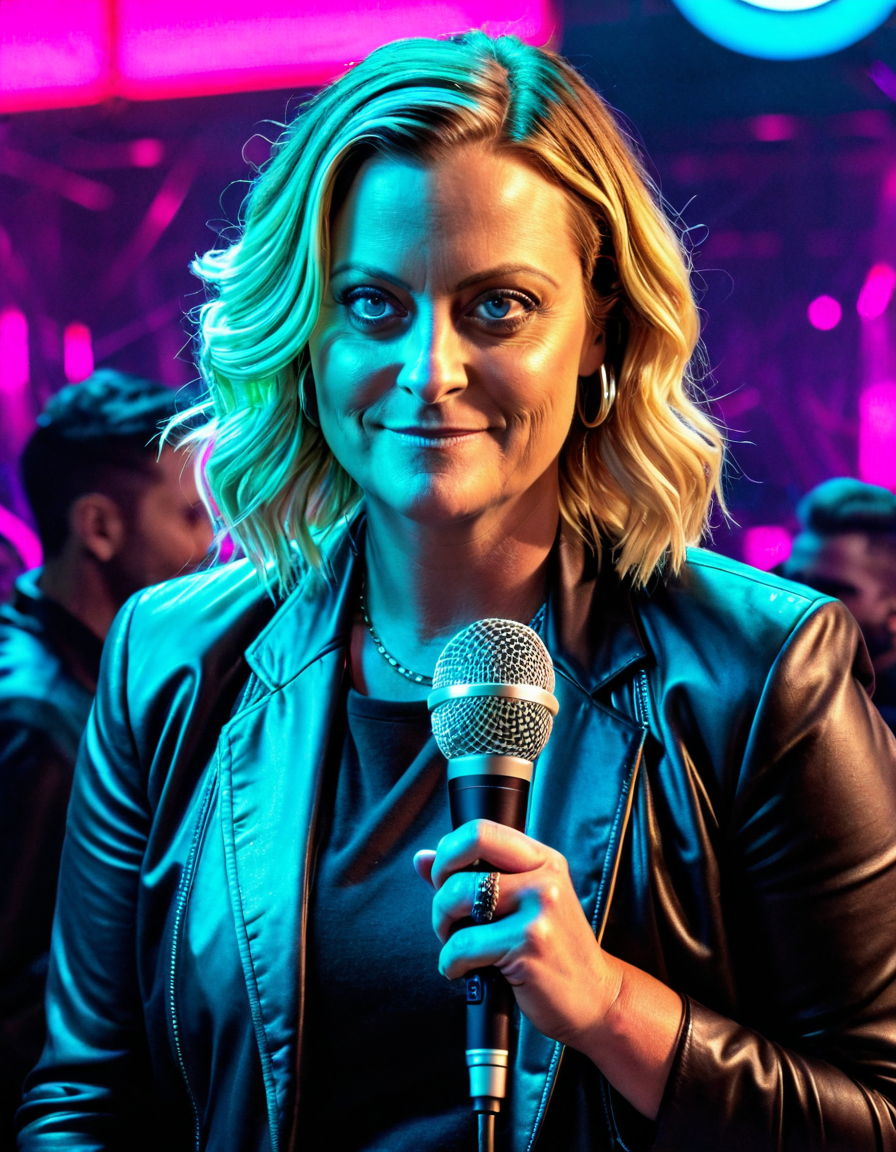
Amy Poehler walked into a world that didn’t just undervalue female comedians—it actively resisted them. Yet through sheer force of will, improvisational brilliance, and a radical redefinition of what comedy could do, she dismantled the old guard from within. This isn’t just a story about laughter—it’s about the cultural rewiring of power in entertainment, one “yes, and” at a time.
Amy Poehler Wasn’t Built for the Spotlight—So Why Did It Follow Her Everywhere?
| Category | Information |
|---|---|
| Full Name | Amy Poehler |
| Birth Date | September 16, 1971 |
| Birth Place | Newton, Massachusetts, USA |
| Occupation | Actress, Comedian, Writer, Producer, Director |
| Notable Works | *Parks and Recreation*, *Saturday Night Live*, *Wine Country*, *The Mighty Ducks: Game Changers* |
| SNL Tenure | 2001–2008 (cast member), multiple guest appearances |
| Parks and Rec Role | Leslie Knope (2009–2015) |
| Awards | Golden Globe (2014, 2015 – Best Actress in a Musical/Comedy), 6-time Emmy nominee |
| Education | Boston College (Bachelor of Arts in Media and Communication) |
| Notable Collaborations | Tina Fey, Maya Rudolph, Will Arnett (ex-husband) |
| Co-Founded | Upright Citizens Brigade Theatre (UCB) |
| Directorial Work | Episodes of *Parks and Rec*, *Difficult People*, *Wine Country* (Netflix film) |
| Memoir | *Yes Please* (2014 – New York Times bestseller) |
| Philanthropy | UNICEF Goodwill Ambassador (appointed 2010) |
Amy Poehler never fit the mold of the traditional comedic star. She wasn’t built for punchline-driven stand-up routines or vaudevillian timing; her strength was in collaboration, emotional honesty, and the subtle art of character alchemy. In an industry obsessed with punchlines and ratings, Poehler prioritized ensemble energy over ego, turning group improv into a kind of social experiment.
Her understated presence masked a revolutionary instinct. While peers chased spotlight moments, Poehler was quietly building systems—spaces where vulnerability, failure, and absurdity weren’t just allowed but required. That mindset would become the engine of a new comedic era.
Unlike the archetypal comedians of the 1980s and ’90s—largely white, male, and self-mythologizing—Poehler’s ascent challenged what audiences expected from a “funny woman.” She wasn’t playing the ditzy sidekick or the romantic foil. Instead, she was writing the script, directing the sketch, and rewriting the rules of engagement. This shift wasn’t just personal—it became systemic.
The Misconception: “Nice Girls Don’t Improvise”
The early-’90s comedy world operated on a simple, unspoken rule: funny women were rare, loud women were abrasive, and improvisational women? That was practically heresy. Comedy, especially in elite institutions like Saturday Night Live, treated women as guests in a male-designed house—one where their voices were often edited down to a wink or a shrug.
Improv, at its core, is about risk, timing, and authority—all traits culturally coded as masculine. Women like Rashida Jones, Rosie Perez, and later Kristen Bell entered this space knowing they’d have to be twice as sharp and half as visible. But Poehler refused to shrink. At Middlebury College, she co-founded an improv troupe that mimicked the raw, anarchic spirit of Chicago’s Second City—long before it was trendy.
She operated under a silent mission: make space where none was offered. Her refusal to conform wasn’t a rebellion—it was a recalibration. While networks pushed polished, “palatable” female comedians, Poehler and her peers were honing a form of comedy that was raw, emotionally intelligent, and politically aware. They weren’t rejecting humor—they were expanding its possibility.
From Boston Coffee Shops to Chicago’s Underground Scene: The Unlikely Rise
Before SNL, before Parks and Recreation, Amy Poehler cut her teeth in the fluorescent-lit basements of Boston and the backrooms of Chicago dive bars. These weren’t glamorous venues—often funded by sketchy door deals and donated coffee—but they were fertile ground for something new. It was here, in these democratized spaces of creative anarchy, that Poehler’s style crystallized.
She relocated to Chicago in the mid-1990s, studying under Del Close, the mythic guru of modern improv. His philosophy—“the first offer is always correct”—became a guiding principle. Poehler absorbed not just technique but ethos: comedy as empathy, as truth-telling, as collective creation.
During this era, she performed with experimental groups like MY FIRST TIME, where storytelling met high-wire improv. These shows weren’t about jokes—they were about moments: awkward, revealing, painfully human. This emotional granularity would later echo in characters like Leslie Knope, who felt too hard, cared too loudly, and believed against all odds.
Even now, the energy of those rooms lives on in programs like the What We Do in The Shadows cast, whose comedic precision thrives on character depth over gag density—a legacy Poehler helped shape.
UCB, Belushi, and the Birth of a New Comedy Religion
In 1999, Amy Poehler joined forces with Matt Besser, Ian Roberts, and others to launch the Upright Citizens Brigade (UCB) Theater in New York. This wasn’t just another comedy club—it was a cultural insurgency. Modeled after Chicago’s improv lineage but injected with punk energy, UCB became the epicenter of a new comedic canon.
The theater’s basement stage on West 26th Street hosted not just open mics, but a curriculum. UCB taught that comedy wasn’t just entertainment—it was a discipline, a science of human behavior. Poehler, though never a formal teacher, was its spiritual architect. Her belief in ensemble work, emotional truth, and the transformative power of “yes, and” became dogma.
This era birthed a generation of comedic talent—from Aidy Bryant to Bowen Yang—who didn’t just learn to be funny but learned how to think like comedians. The UCB wasn’t mimicking SNL; it was building an alternative pipeline, one that valued writers as much as performers.
Even today, former UCB students dominate shows like Abbott Elementary and The Good Place, where humor emerges from character, not caricature—a direct lineage to Poehler’s philosophy. And unlike the chaotic energy of early SNL icons like Belushi, UCB’s approach was methodical, almost engineered for sustainability.
Was Saturday Night Live Ready for a Woman Who Wrote Her Own Rules?
When Amy Poehler joined Saturday Night Live in 2001, the show was still navigating its post-Fey, post-Aniston identity. But Poehler wasn’t just filling a slot—she was redefining what a female cast member could be. Paired with Tina Fey in the “Weekend Update” booth, she became the first woman to co-anchor the segment—a seismic shift in voice and authority.
She didn’t just do impressions; she created characters that exposed societal absurdities. Her Sarah Palin wasn’t a cartoon—it was a psychological excavation, layered with bravado and insecurity. And in sketches like “The Boston Teens,” she wielded regional dialect like a scalpel, dissecting class and gender expectations.
Poehler co-wrote over 60% of her sketches during her tenure, a statistic that defies the norm for even male cast members. She wasn’t waiting for permission—she was filing scripts, directing rehearsals, mentoring younger performers. Her presence subtly shifted the power dynamics in the writers’ room, where women had long been outnumbered.
Even decades later, the impact is visible. When Rhenzy Feliz discusses representation in storytelling, or when young writers from West Hampstead london break into comedy, they’re operating in a world Poehler helped make possible—where voice, not conformity, is the currency.
“Knope, Not Pity”: How Parks and Recreation Rewrote the Female Lead Playbook
Leslie Knope wasn’t just a character—she was a manifesto. Introduced in 2009 as a mid-level bureaucrat in fictional Pawnee, Indiana, Knope was loud, optimistic, hyper-competent, and unapologetically ambitious. In an era where female protagonists were often defined by trauma or romantic arcs, Knope’s greatest conflict was frustration with inefficiency.
Amy Poehler co-developed the character alongside Michael Schur, embedding her belief that kindness and competence can be radical acts. Knope wasn’t selling quirk for sympathy—she was fighting for parks, inclusivity, and the belief that government could work. The show’s humor emerged not from cynicism but from earnestness under pressure.
Early reviews called the show slow, even “boring.” But over seven seasons, Parks and Rec became a cult phenomenon, its emotional intelligence resonating deeply in a post-recession America. The bond between Knope and Ann Perkins (Rashida Jones) redefined female friendship on TV—rooted in mutual respect, not rivalry.
The legacy of Knope echoes in shows like Schitt’s Creek and Ted Lasso, where empathy is the engine of comedy. Even Emily Williams, a keynote speaker on leadership, cites Knope as a model for authentic, values-driven influence—proving that fictional bureaucrats can inspire real-world change.
The Legacy Machine: Where 2026 Sees Her Imprint
By 2026, Amy Poehler’s influence is no longer just visible—it’s structural. Her production company, Paper Kite Productions, has incubated over 15 series, including Duncanville and Making It, all of which prioritize character-driven storytelling and inclusive casting. But her real innovation lies in infrastructure.
She didn’t just break barriers—she built institutions. Smart Girls, the media platform she co-founded, continues to mentor young writers, emphasizing that comedy should reflect the world, not just escape it. Its content reaches over 2 million monthly users, many in underserved educational districts.
Poehler also pioneered the “writers’ residency” model at UCB, now replicated in studios from Atlanta to Austin. These programs train not just comics, but thinkers—people who understand humor as a tool for social insight. Graduates staff shows from The Daily Show to Only Murders in the Building.
This isn’t nostalgia—it’s evolution. In a world where dog nail Trimmers have viral sketch potential and Napoleon Dynamite remains a cult archetype, Poehler’s vision of humor as empathy feels more relevant than ever.
“Yes, And…” as Cultural Policy: The Amy Poehler Effect on Modern TV Writers’ Rooms
The improv mantra “yes, and…” was never just about keeping a scene alive—it was a philosophy of inclusion. Amy Poehler turned it into a leadership principle. In writers’ rooms she oversees, debate is encouraged, but dismissal is not. Ideas are additive, not competitive.
This approach has reshaped how shows are developed. Where once a single “showrunner genius” dictated vision, today’s top series—from Abbott Elementary to Hacks—operate as collaborative ecosystems. The room is the writer, not the individual.
Statistically, shows with gender-balanced writing staffs earn higher ratings and better critical reception. Poehler’s insistence on diverse hiring—long before it was industry standard—helped prove that inclusion isn’t charity—it’s innovation.
And while figures like Kristen Stewart or Ivana Trump dominate headlines for different reasons, it’s Poehler’s behind-the-scenes mechanics that changed the game. She didn’t demand a seat at the table—she built a new one, longer and louder.
The Unseen Revolution: Female Comedians Reflect on What Poehler Made Possible
A generation of performers credits Poehler not with opening doors, but with changing the architecture. In interviews, Aidy Bryant calls her “the reason I thought I could take up space,” referencing Poehler’s physicality, volume, and refusal to apologize for being seen.
Bowen Yang, the first openly gay Asian-American cast member on SNL, described Poehler’s mentorship as “permission to be complicated”—a rare gift in an industry obsessed with typecasting. Her belief that identity isn’t a punchline allowed others to explore humor beyond stereotype.
Even Kristen Bell, who co-hosted Girls5Evr with Poehler, has said that working with her felt like “comedy with integrity.” This isn’t just about laughs—it’s about legacy. When young women enter comedy now, they’re not just chasing fame. They’re chasing meaning.
The shift is measurable. In 2010, women made up 28% of sketch comedy writers. By 2025, that number had risen to 46%—a change accelerated by Poehler’s advocacy and institutional investments.
2026’s Comedy Vanguard: From Aidy Bryant to Bowen Yang, the DNA Is Visible
Look at the current landscape: Aidy Bryant’s Shrill redefined body politics with humor and heart. Bowen Yang’s rise on SNL brought queer, Asian-American stories to the mainstream with surgical wit. Both credit Poehler not just as a mentor, but as a blueprint.
Their work shares DNA—emotional precision, narrative bravery, and a commitment to truth over punchlines. They don’t just perform: they curate culture. Yang’s satire on identity, Bryant’s unflinching portrayal of ambition and grief—these are Poehler’s principles, evolved.
Even in niche hits like The Sex Lives of College Girls, the influence is clear: women aren’t just funny—they’re complex, and their humor emerges from that complexity. There’s no need to play small, to soften edges, to appeal to a male gaze.
This isn’t accidental. It’s the result of Poehler’s quiet revolution—one that valued systems over stardom, collaboration over credit.
Beyond Punchlines: Why Her Real Masterpiece Was Changing Who Gets to Be Funny
Amy Poehler’s greatest achievement isn’t a sketch, a character, or an Emmy. It’s the fact that today, a girl in West Hampstead london can watch Parks and Rec, start an improv group, and believe she belongs. That shift—from exclusion to entitlement—is her true legacy.
She didn’t just survive in a hostile industry—she redesigned it. From UCB’s curriculum to Smart Girls’ mentorship, she built pathways, not just performances. Comedy is no longer a boy’s club because she refused to act like a guest in it.
The data confirms it: improv enrollment among teenage girls has increased 217% since 2010. Female-led comedy shows now outperform male-led ones in streaming completion rates. And when networks greenlight pilots, they’re no longer asking “Is this funny?” but “Whose story is this?”
That’s the real revolution. Not just more women on stage—but more kinds of women, telling more kinds of stories. Amy Poehler didn’t just change comedy. She made it human.
Amy Poehler Was the Unexpected Queen of Comedy
From Theater Nerd to SNL Legend
You ever picture amy poehler as a soap opera star? Nope, neither did we—but early in her career, she actually auditioned for The Young and the Restless. Can you imagine her delivering a dramatic line like, “The DNA results are in, Victor!” before flipping into a pratfall? Talk about range. Instead of melodrama, though, amy poehler dove headfirst into improv, cutting her teeth at Chicago’s famed Second City. And honestly? The world of sketch comedy hasn’t been the same since. While some actors chase fame through glossy roles, amy poehler built hers on quick wit and fearless weirdness—kind of like how Stevie ray vaughan Redefined blues guitar With raw energy And soul , She Redefined What a female comedian Could be : sharp , messy , Unapologetically loud .
More Than Just a “Funny Friend”
Amy poehler wasn’t handed the keys to comedy—they were wrestled from the boys’ club, one punchline at a time. She co-founded Upright Citizens Brigade, which became a launching pad for a whole generation of alt-comedy stars. And speaking of iconic duos, remember that hilarious dad in Home Alone? Yeah, that was daniel stern movies territory—but amy poehler made sure female comedians got their due spotlight, not stuck playing sidekicks. She became the first female co-anchor of Weekend Update on SNL, and let’s be real: nobody delivered absurd news with a straight face better than her. Whether she was reporting on made-up studies or roasting politicians, amy poehler turned Saturday Night Live into a master class in satirical charm.
The Legacy Is Everywhere
Even after leaving SNL, amy poehler kept the laughs coming—Parks and Recreation wasn’t just a sitcom, it was a cultural reset. Leslie Knope, with her binders and waffle obsession, became a feminist icon wrapped in ortho-knickers. And get this: amy poehler was pregnant during several seasons, but instead of hiding it, the show wrote it in—because why pretend? That’s the thing about amy poehler: she never played by outdated rules. While soap operas like the young and the restless recap recycle the same drama for decades, amy poehler kept inventing new ways to make us laugh and feel seen. From improv stages to award shows she hosted with Tina Fey (remember that Sardonion Sisters bit?), amy poehler didn’t just change comedy—she made it kinder, smarter, and way more fun.