
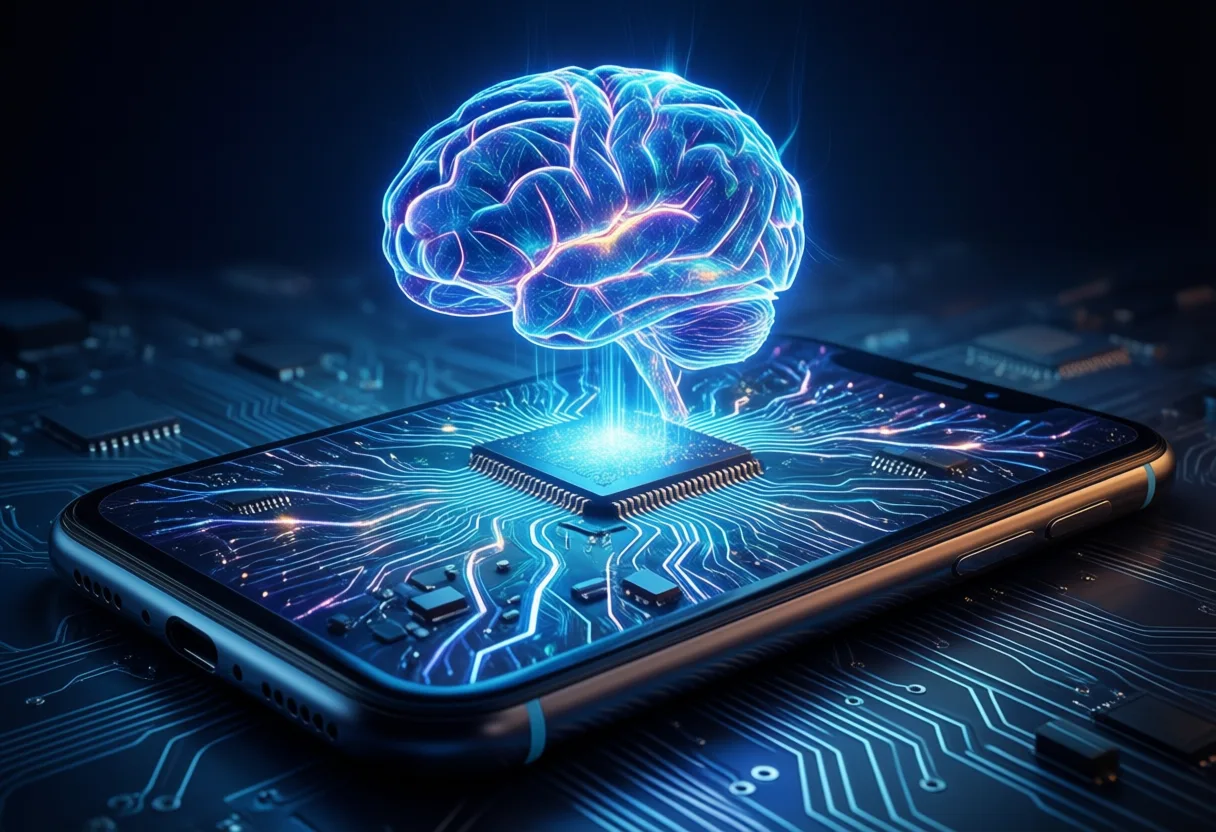
Artificial intelligence is no longer confined to distant data centers. It now lives in your pocket, on your desk, and even on your wrist—powered by on-device AI that processes data locally, instantly, and often without you even noticing. This shift is transforming how phones and laptops understand the world, respond to commands, and protect your privacy.
What Is On-Device AI, and Why It’s Changing Personal Computing — How On-Device Ai Works On Phones And Laptops
On-device AI refers to the ability of smartphones, laptops, and other devices to run artificial intelligence tasks directly on the hardware, without needing to send data to remote servers. This means the intelligence is embedded in the device itself, allowing it to make decisions in real time based on local data.
Instead of relying on a constant internet connection, on-device AI performs computations where the data is generated. This reduces delays, improves responsiveness, and gives users more control over their information. Tasks like voice recognition, image enhancement, and predictive typing can now happen instantly, right on the device.
The rise of on-device AI marks a fundamental shift in personal computing. Devices are no longer just tools that fetch intelligence from the cloud—they are becoming Autonomous agents Capable of learning, adapting, and acting independently. This evolution is making technology more intuitive, efficient, and secure.

How Local Processing Unlocks Real-Time AI Without the Cloud
Local processing enables AI to operate without depending on cloud servers. When a device uses on-device AI, it analyzes and interprets data using its own computational resources. This eliminates the need to transmit information over the internet, which can be slow or unreliable.
Consider taking a photo in a dimly lit room. With on-device AI, the phone instantly recognizes the low-light scene and adjusts exposure, color balance, and noise reduction—all within milliseconds. There’s no delay waiting for a server to respond because the Decision-making happens locally.
Real-time responsiveness is critical for applications like augmented reality, live translation, and voice assistants. These features demand immediate feedback. Local processing ensures that interactions feel natural and seamless, even in areas with poor connectivity. The result is a more fluid, uninterrupted user experience.

Why Your Phone Can Now Think for Itself
Modern smartphones are no longer just communication tools—they are intelligent companions. Thanks to on-device AI, they can now interpret context, recognize patterns, and adapt to user behavior without external help. This autonomy allows them to anticipate needs and act proactively.
For example, your phone might learn your daily routine and automatically enable silent mode when you enter a meeting. It could suggest calling a family member based on time of day and past behavior—all processed locally. These insights are drawn from data that never leaves the device.
This level of independent reasoning is powered by specialized hardware and optimized software working in tandem. The device doesn’t just follow instructions—it Learns from experience And makes decisions based on that knowledge. As a result, your phone becomes more personalized, efficient, and useful over time.

The Shift from Cloud-Dependent to Device-Bound Intelligence
For years, AI relied heavily on cloud computing. Large models required massive servers to process data, which meant sending personal information across the internet. While powerful, this approach introduced latency, privacy concerns, and dependency on connectivity.
Now, the tide is turning. On-device AI brings computation back to the endpoint—your phone or laptop. This shift reduces reliance on remote infrastructure and puts control back in the user’s hands. Intelligence is no longer centralized; it’s Distributed across millions of devices.
This transition doesn’t mean the cloud is obsolete. In fact, the cloud still plays a crucial role in training large AI models. But once trained, these models can be compressed and deployed locally for inference—the process of making predictions based on new data. The result is a hybrid system where the cloud teaches, and the device learns to act independently.
Inside the Hardware: What Powers On-Device AI?
On-device AI is made possible by advanced chipsets designed specifically for machine learning tasks. Modern processors include dedicated components like NPUs (Neural Processing Units), GPUs, and AI accelerators that handle complex computations efficiently. These units are optimized for the parallel processing demands of AI workloads.
NPUs, in particular, are engineered to execute neural network operations with high speed and low power consumption. They can process thousands of calculations simultaneously, making them ideal for tasks like facial recognition or natural language understanding. Their efficiency allows AI to run continuously without draining the battery.
Smartphones and laptops now come with system-on-chips (SoCs) that integrate CPU, GPU, and NPU into a single package. This tight integration enables seamless coordination between components, maximizing performance while minimizing energy use. As these chips evolve, so does the potential for more sophisticated on-device AI capabilities.
From Training in the Cloud to Running Locally on Devices
AI models begin their life in the cloud, where vast datasets are used to train them. This phase requires immense computational power and storage—resources typically available only in large data centers. Once trained, the model is fine-tuned and compressed for deployment on consumer devices.
The compressed model is then embedded into the device’s operating system or apps. When you speak to a voice assistant or use a camera filter, the device runs AI inferencing locally, using the pre-trained model to interpret your input. No raw data needs to be sent back to the cloud for analysis.
This two-stage approach combines the best of both worlds: the cloud provides the heavy lifting of training, while the device handles real-time execution. It allows manufacturers to deliver powerful AI features without compromising speed or privacy. The model stays up to date through periodic downloads, ensuring continuous improvement.
How Scene Recognition and Camera Optimization Work Instantly
Many phones use on-device AI to analyze the scene and make adjustments locally, leveraging NPUs or machine learning models specifically designed for image processing. When you point your camera at a landscape, pet, or night sky, the device instantly identifies the subject and optimizes settings accordingly.
This happens through a process called Real-time classification. The AI model compares the incoming image data against learned patterns to determine what’s in the frame. Based on that recognition, it adjusts focus, exposure, white balance, and even applies filters or enhancements tailored to the scene type.
Because all of this occurs on the device, there’s no lag or need for internet access. You see the optimized preview instantly in the viewfinder. This capability has elevated smartphone photography to levels once reserved for professional cameras, making advanced imaging accessible to everyone.
When Privacy Meets Performance: The Edge Advantage
One of the most compelling benefits of on-device AI is enhanced privacy. Since data is processed locally, sensitive information like voice recordings, messages, and photos never leave the device. This minimizes the risk of exposure during transmission or storage on remote servers.
This edge-based approach also improves performance. Without the round-trip to the cloud, responses are faster and more reliable. Features like voice dictation, face unlock, and health tracking can operate securely and efficiently, even offline. Users get both Speed and peace of mind.
Moreover, local processing aligns with growing concerns about data ownership and surveillance. By keeping personal data on-device, companies reduce their liability and users gain greater transparency. As regulations tighten around data privacy, on-device AI offers a sustainable path forward for ethical AI development.
On-Device Language Models: Can a Smartphone Run an LLM?
An on-device LLM (Large Language Model) is a type of AI language model that runs entirely on a mobile device, laptop, or other local hardware. While full-scale models like those powering web-based chatbots require cloud infrastructure, smaller, optimized versions can operate locally.
These compact models are designed to handle common tasks such as text prediction, grammar correction, and basic conversational responses. They may not match the breadth of cloud-based counterparts, but they offer Fast, private, and reliable performance Without connectivity.
Developers achieve this by pruning unnecessary parameters, quantizing weights, and using efficient architectures. The result is a model small enough to fit on a phone yet powerful enough to support meaningful interactions. As compression techniques improve, we’re seeing increasingly capable on-device language systems emerge.
Balancing Power, Heat, and Speed in Mobile AI Tasks
Running AI on a mobile device presents unique engineering challenges. The hardware must deliver high performance while managing limited battery life and thermal constraints. An AI task that drains power too quickly or overheats the device defeats the purpose of local processing.
Chipmakers address this by designing AI accelerators that maximize efficiency per watt. These components perform more calculations with less energy, allowing sustained AI activity without rapid battery depletion. Thermal management systems also help dissipate heat generated during intensive workloads.
Software optimizations play a key role too. Operating systems prioritize AI tasks dynamically, allocating resources only when needed. Background processes are minimized, and models are streamlined to reduce computational load. Together, these strategies ensure that AI enhances—not hinders—device usability.
Beyond Smartphones: Laptops and Wearables Join the On-Device Wave
While smartphones led the charge, on-device AI is now expanding to laptops, tablets, and wearables. Laptops use local AI to enhance video conferencing, optimize battery usage, and improve typing accuracy. Wearables leverage it for health monitoring, activity detection, and voice commands.
These devices benefit from the same principles: faster response times, improved privacy, and offline functionality. A smartwatch can detect a fall and call for help without a phone or network connection. A laptop can blur your background during a call using only its onboard processor.
As AI chips become more energy-efficient and compact, they’re being integrated into an expanding range of form factors. The result is a More intelligent ecosystem Where every device contributes to a seamless, context-aware experience. The future of computing isn’t just connected—it’s cognitively distributed.
What Users Gain—and Give Up—with Local AI Processing
Users gain speed, privacy, and reliability with on-device AI. Tasks execute instantly, personal data stays protected, and functionality remains available even without internet access. These advantages make technology more trustworthy and accessible in everyday life.
However, there are trade-offs. Local models are typically smaller and less capable than their cloud-based counterparts. They can’t access real-time updates or vast knowledge bases, limiting their scope. Some complex queries still require cloud assistance for accurate answers.
Additionally, not all devices have the hardware to support advanced on-device AI. Older models may lack NPUs or sufficient memory, restricting access to the latest features. As the gap widens between high-end and budget devices, Unequal AI access Could become a growing concern.
The Silent Engine Behind Smarter, Faster, Offline-Capable Devices
On-device AI is the quiet force powering the next generation of smart devices. It enables phones and laptops to process information locally, making them faster, more private, and more capable than ever before. This shift is not flashy—but its impact is profound.
From enhancing photos to understanding speech and predicting behavior, local AI works behind the scenes to create a smoother, more intuitive experience. It turns ordinary devices into intelligent partners that learn, adapt, and respond in real time.
As hardware improves and models become more efficient, the boundary between human and machine will continue to blur. The devices we carry are no longer just tools—they are thinking, reacting, evolving systems. And they’re doing it all, right here, right now, on the device.
Why Your Phone Thinks for Itself
You might not realize it, but your smartphone or laptop could already be making smart decisions without calling home. On-device AI means the device runs artificial intelligence tasks right where the data lives—on your hardware—instead of sending everything to a distant server. This local processing taps into specialized chipsets built into modern devices, allowing them to handle complex computations quickly and privately. Think of it like having a tiny brain inside your phone that learns from what you do, all without needing constant internet access.
Smarter Photos, Faster Replies
Ever noticed how your camera instantly recognizes a sunset or a pet’s face? That’s on-device AI in action. Many phones use local AI to analyze scenes in real time, adjusting lighting and focus using dedicated processors called NPUs (Neural Processing Units). These chips are champs at running machine learning models efficiently, so your battery doesn’t pay too high a price. Even typing suggestions or voice assistants can work offline, thanks to compact language models that live directly on your device. No upload, no lag, just quick smarts baked into everyday functions.
Privacy with a Side of Speed
One of the coolest perks of on-device AI is keeping your data close. Since your messages, photos, and voice commands don’t need to travel to the cloud, there’s less risk of exposure during transmission. Tasks like translating text or summarizing notes happen locally, which also means they’re often faster—no waiting for round-trip server calls. And while large AI models usually train in data centers, lightweight versions are optimized to run solo on your gadget, proving that powerful AI doesn’t always need a massive infrastructure behind it.
Frequently Asked Questions
What is on-device AI?
On-device AI refers to running artificial intelligence tasks directly on smartphones, laptops, or other devices using local hardware. It processes data locally without sending it to remote servers, enabling real-time decisions and improved privacy.
How does on-device AI improve privacy?
Since data is processed locally, sensitive information like voice recordings, messages, and photos never leave the device. This minimizes exposure risks during transmission or storage on remote servers.
Can a smartphone run a large language model?
Yes, smaller, optimized versions of large language models can run locally on smartphones. These compact models handle tasks like text prediction and basic conversations without needing cloud connectivity.
What hardware powers on-device AI?
On-device AI is powered by specialized components like NPUs (Neural Processing Units), GPUs, and AI accelerators. These are often integrated into system-on-chips (SoCs) that combine CPU, GPU, and NPU for efficient processing.
Related reading
This article was produced with AI assistance. How Neuron Magazine uses AI.
Neuron Magazine writes for Neuron Magazine — technology news, science, ai, robots and the future.